43607
Euromold 2014 – Everything You Need to Know About the Future of 3D Printing
2014 was a very eventful year. Fortunately, not only in the political sense, but also around our topic – additive technologies and 3D printing. Traditionally, several dozen conferences and exhibitions take place per year, at which all participants in the world market, in one form or another, talk about their achievements.
I have been to foreign exhibitions as a guest, and to Russian exhibitions as a participant of the 3DPrintus company. The first two exhibitions, Inside3DPrinting in New York and 3D Printshow in London, are focused primarily on companies that provide services for 3D printing, scanning, creating useful software, and so on.
The current Euromold exhibition in Frankfurt, which we will talk about, is the largest in the world and brings together not only participants in the additive technologies market, but also traditional production. Euromold always announces and demonstrates new equipment and professional software solutions.
In this publication, I do not aim to tell you in detail about what models of 3D printers or materials were presented by manufacturers (this information is easy to find on thematic sites). First of all, I will share the insights of the industry and the conclusions that I made while communicating with its representatives. And I will try to answer the question: Where is the development of technology and its application in the real world going?
Popularization
Formally, many people have heard of 3D printing, but the application of the technology is still very far from the mass market. This is due to such obstacles as knowledge of materials, the availability of a 3D model, and the non-obviousness of the application of technology for customer tasks. And, of course, people's inertia to everything new in general.
Some companies in the market are trying to solve this problem. Each does it in her own way.
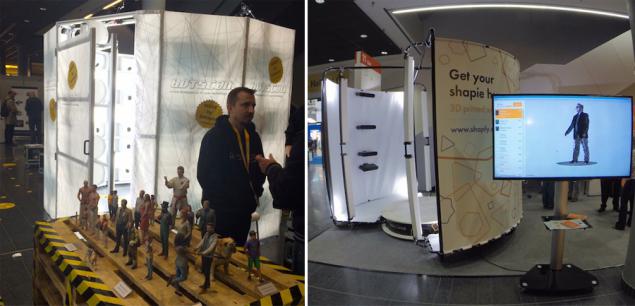
Artec Group has launched its Shapify service, which allows anyone to instantly make a 3D scan and get a miniature copy of themselves in color after a while. Artec assembled a large booth with lighting and scanners in a circle, which is used to make a 3D scan of a person.
As you can see, Shapify is not the only solution with its 3D booth (Botscan was on the other side of the same pavilion), however, as far as I know, it is the most successful in terms of cloud infrastructure, support for calculating and fixing models, which makes life much easier for those who want to do business on it.
The solution itself is sold on a turnkey basis and you can take a risk and launch your business by finding a good combination of location, traffic from people and reliable 3D printing partners. Franchise prices from Shapify are here.

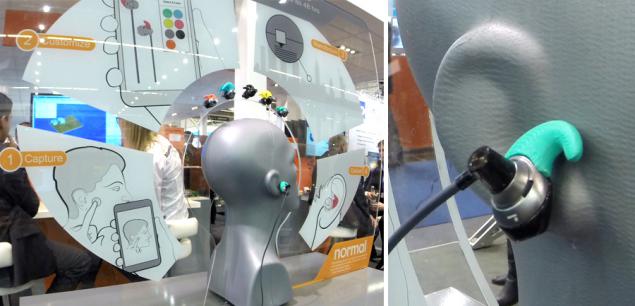
Widely known in narrow circles, the Normal startup offers to look and touch their product - a customizable headphone pad made specifically for the client's ears. And they, as you know, are very individual.
This is one of the latest examples of the combination of traditional mass production technologies and the personalization of 3D printing.
In my opinion, this is quite a good solution and in cooperation with Stratasys it will go actively to the masses.
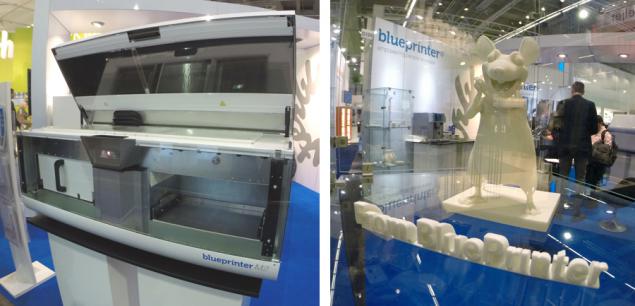
Budget (almost) Blueprinter printers, printing models using Selective Thermal Sintering (SHS) technology, have been on the market for several years, and recently the price for them has increased from 10 thousand dollars to 25 thousand dollars. However, it is the most affordable printer that allows you to produce parts in a small chamber (200 x 157 x 140 mm) from the most popular material – polyamide.
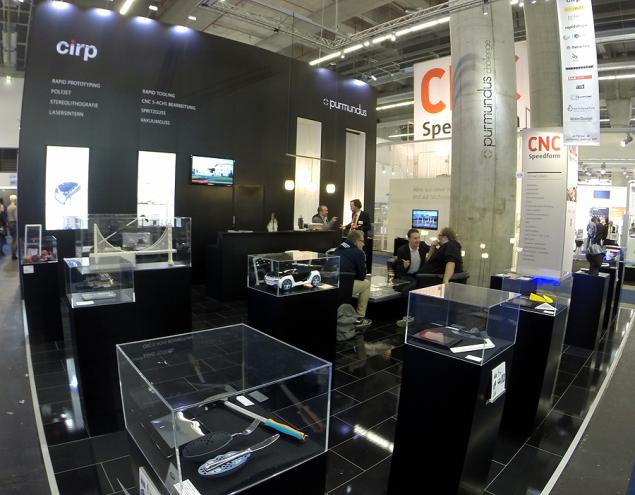
Companies that provide rapid prototyping services also do not respond to the popularization of the technology. Instead of hosting complex engineering solutions or prototypes, they show beautiful final items that are pleasant to look at and touch. In this way, they show not the process and their services, but the result and joy for the client.
This is a very useful approach that conveys to visitors the idea that technology is close to ordinary people and is used to their advantage.
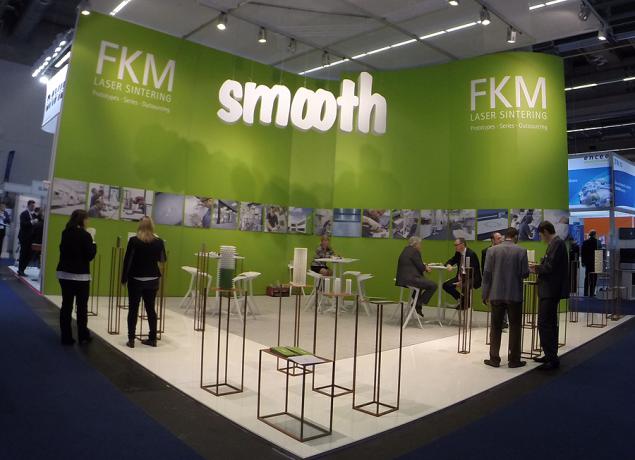
From the point of view of the most popular material for 3D printing (after "home" ABS/PLA), the absolute leader is polyamide (nylon). Manufacturers providing 3D printing services buy EOS machines in large quantities and build their business on the technologies of this manufacturer. Moreover, the recently announced porcelain material will also be produced with the same material.
3D printing that is not talked about on TV
It so happened that all the major innovations and the so-called third industrial revolution in 3D printing are happening outside the media spotlight. Only very close to the topic know about all the new materials, printers and features. The rest of the people (including interested customers) remain in complete ignorance, and therefore the adoption of the technology and widespread commercial adoption among small and medium-sized businesses, as well as B2C, is slow.
Personally, I am extremely interested in disseminating this information to the masses, but without excessive abstruse and excessive immersion in the topic. Because the most interested will be able to find information on their own, and those who will be able to solve their own problems or business problems need to know only about realistic possibilities.
Everything else should be done by services that create a "bridge" between customer needs and production capabilities.
Big machines, big opportunities
Euromold is the place where the concentration of professional and industrial 3D printers is off the charts. All manufacturers try to bring here the best, the greatest and the incredible. This is where major deals are made to purchase such printers.
For example, this year I saw a very large number of Chinese (and even some Indians) who were actively discussing the purchase of printers, which, of course, indicates that China is not asleep not only in mass production, but soon in 3D printing.
One of the brightest stands, around which the most people were all days, was the stand of 3D Systems, one of the leaders in the production of 3D printers.
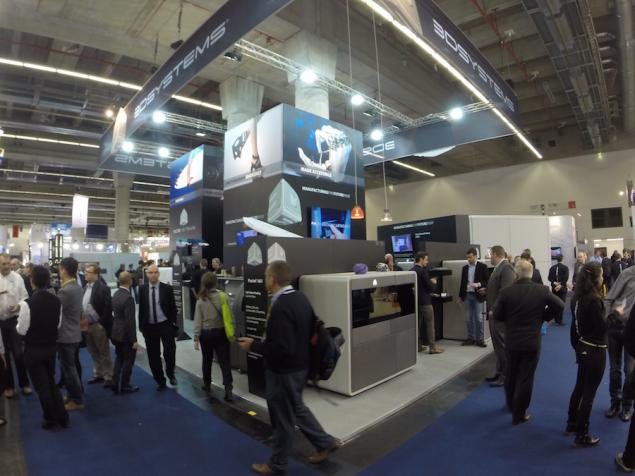
There were 98 3D Systems employees alone in branded equipment. And almost every one of them was constantly busy communicating with a lot of interested visitors.
The company brought all its latest printers printed from gypsum polymer (full-color gypsum), photopolymers (high-precision plastics), metals (titanium, cobal-chromium, steel) and polyamide (durable and flexible plastic).
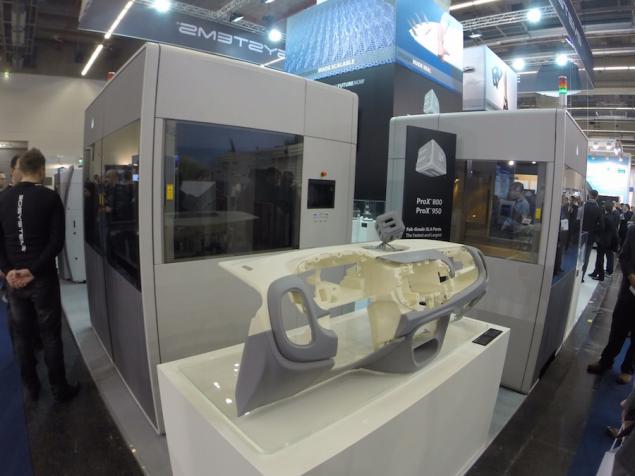
One of the flagships is the ProX 800 SLA printer, which produces very large parts from high-quality and precise photopolymer, which is suitable for the production of prototype car parts.
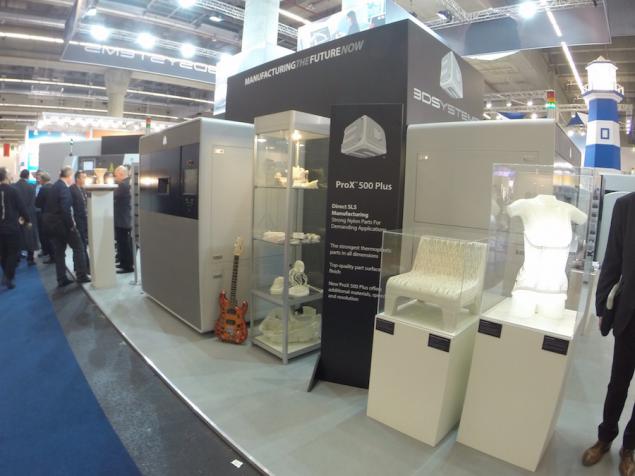
Also, the new printer working on SLS (Selective Laser Sintering) ProX 500Plus technology, allows the company to actively compete with the leader in the field of printing from powder plastics, EOS, whose printers are now used in the vast majority of companies engaged in prototyping from these materials.
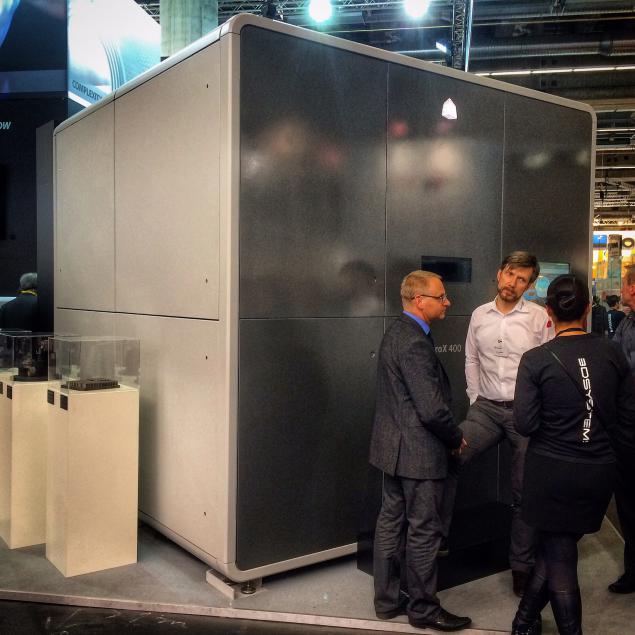
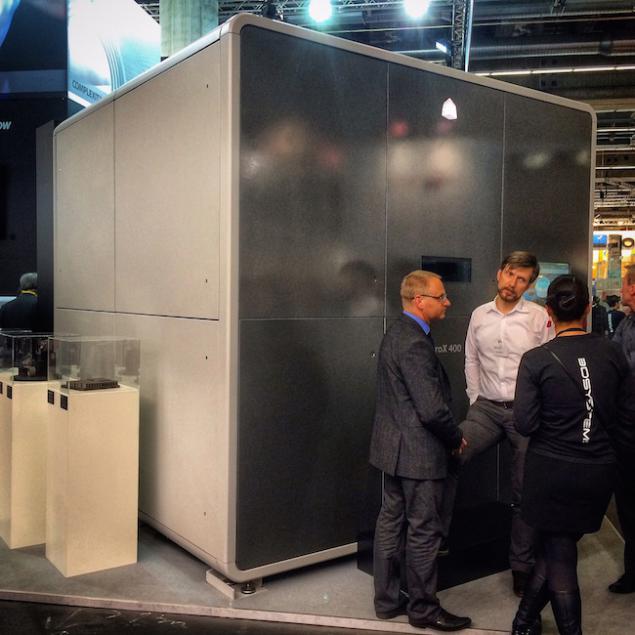
And, of course, the most impressive is the ProX 400 metal 3D printer, weighing several tons, which allows you to make very large parts, up to 500x500x500 mm.
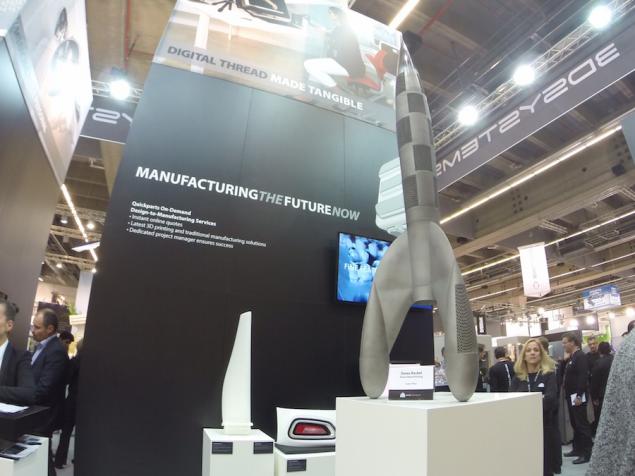
It is worth mentioning that some of the cars brought to exhibitions are just hulls, without stuffing inside. To impress guests, but not to show (and not to drag) too much.
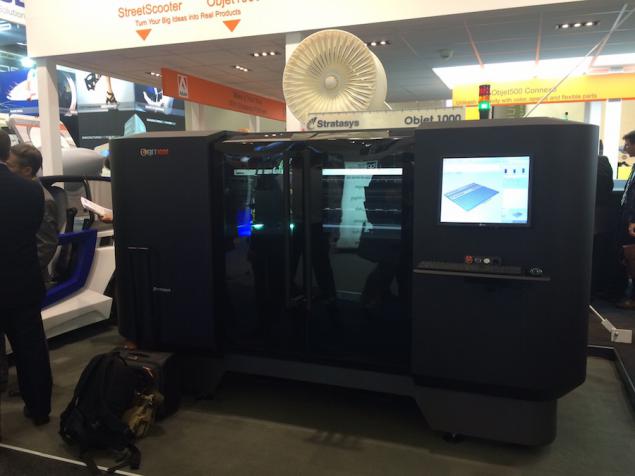
The next huge stand and the leading company is Stratays.
The company decided to play with its entire stand in the aviation theme: here is the fuselage of the aircraft with seats, and business class on the second floor, and many other elements.
Stratasys printers are considered one of the leaders in plastic printing, which the company proves by demonstrating the ability to print both very large parts (pictured above) and medium parts (using its own multi-material multi-color printing technology).
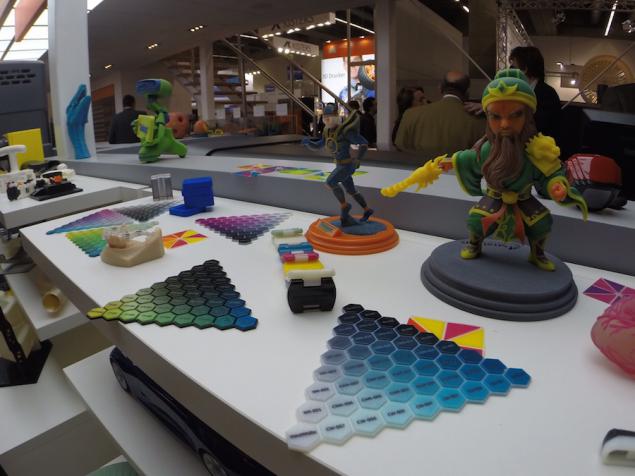
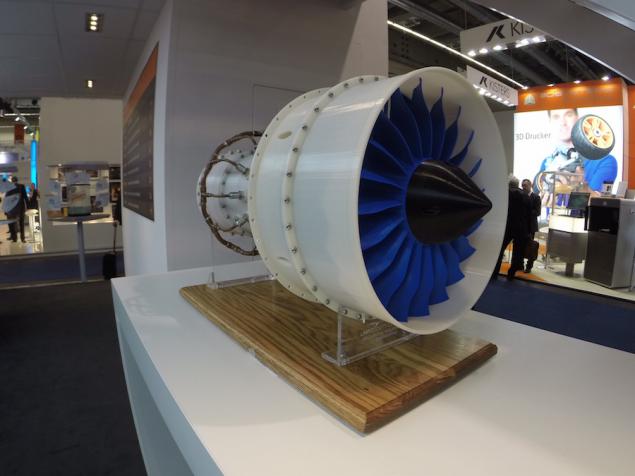
Here, printing uses several colors of plastic at the same time, both durable and flexible (rubber-like), which allows you to get very impressive results.
There are also certain disadvantages in the technology, such as: the high cost of materials (in comparison with full-color gypsum), the limitation on the color palette and the need to change the color palette if you plan to diversify the color of your object.
In general, Stratasys has updated almost its entire fleet of equipment and actively competes with Projet 660 full-color plaster printers from 3D Systems and with the scale of plastic printing with SLA printers from the same 3DS.
However, in my opinion, the most important strategic assets for Stratasys are the companies it bought Grabcad and Makerbot (+Thingiverse) – this is what will allow the company to provide its customers with a full range of capabilities and services around 3D printing.
Leveraging the power of Gradcad's collaborative online platform and a huge community of engineers, as well as Thingiverse's largest archive of 3D models, Stratasys makes buying its equipment even more attractive. In fact, they are building a very correct eco-system. This is a great contribution to future development!
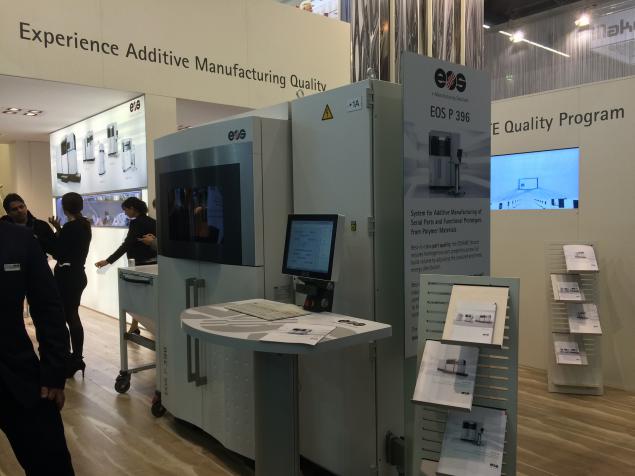
The third industry leader is the German company EOS. A series of printers with the designation EOS P (110, 396, 760, 800) is used in the vast majority of popular 3D printing services, and polyamide products (both prototypes and final products) are considered the best in terms of price/quality ratio.
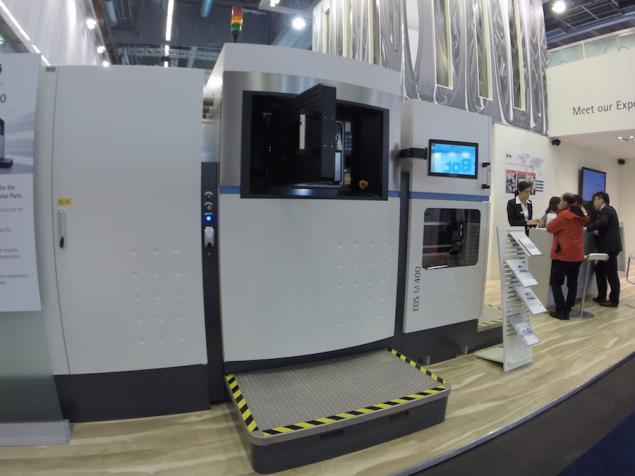
At the show, the company showcased its EOS M400 metal printer with a 400 x 400 x 400 mm camera and the ability to print in cobalt chrome, steel, titanium and other metal powders.
EOS uses a very wide range of materials for its printers, which are very well placed at the company's booth. Two small videos demonstrate this:
And for those who are interested in what the material itself looks like in its original form, the company has prepared test tubes with powders:
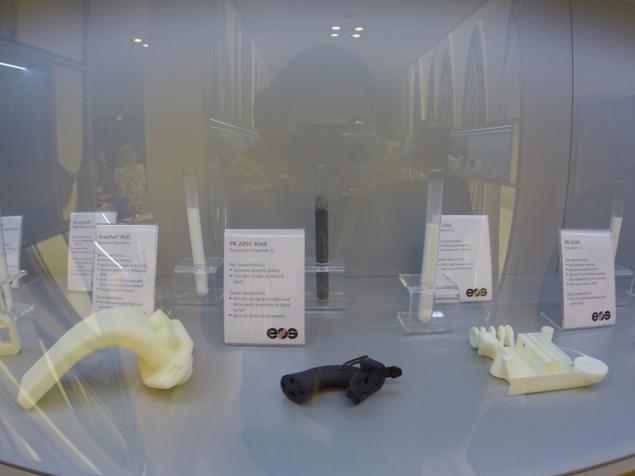
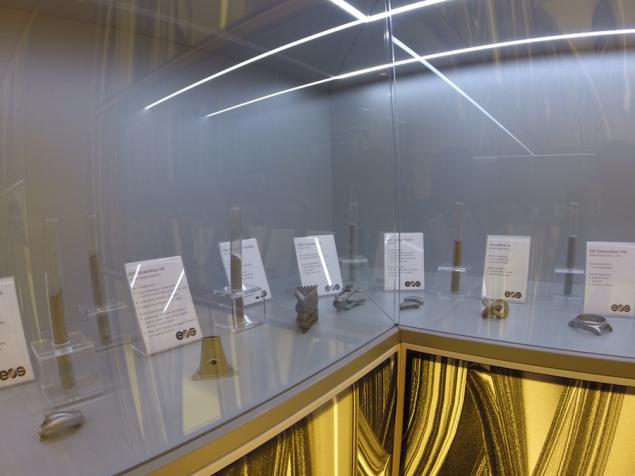
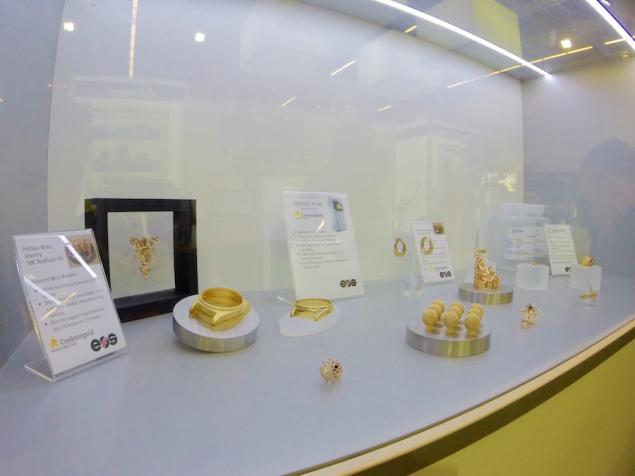
However, one of the company's most exciting releases this year is a partnership with Cooksongold , one of the oldest manufacturers and suppliers of jewellery equipment and materials in the UK.
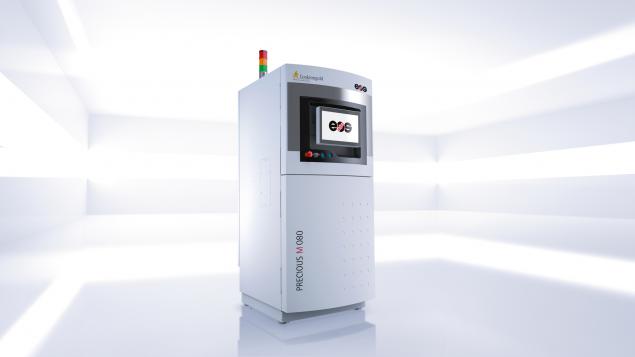
Cooksongold has teamed up with EOS to create a 3D printing printer for precious metals. Cooksongold has developed powders from 18k gold (pink, yellow, white) and uses the M080 printer to create precious pieces with complex shapes that traditional casting cannot handle.
A representative of David Fletcher spoke about the capabilities of the printer for printing jewelry. Here are the main points that I would highlight:
- No design restrictions
- complex shapes that are not available with traditional casting
- thin walls of products
- Light weight, hollow products
- Production of non-separable joints
- Short production time, from 4 hours + 1.5-2 hours for processing
At the same time, 99% of unused powder is reused in production.
David showed several samples of products.
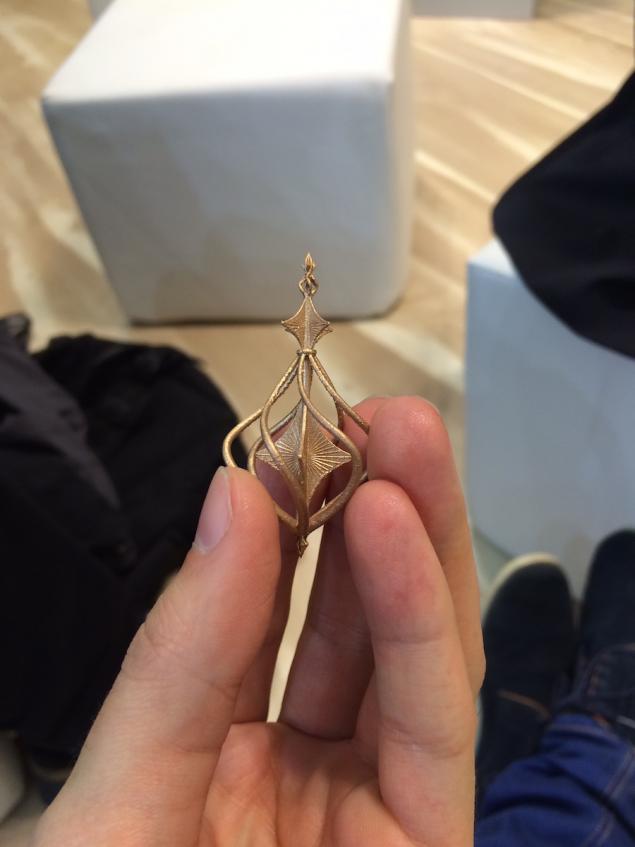
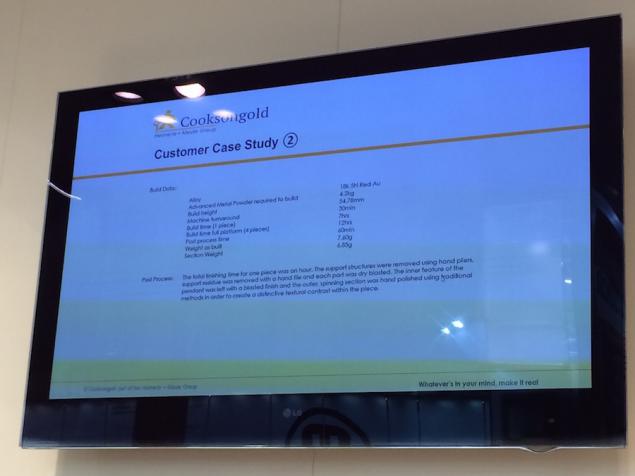
This is a suspension with a rotating element inside. Everything is printed at once.
All the parameters for the manufacture of the suspension can be seen below:
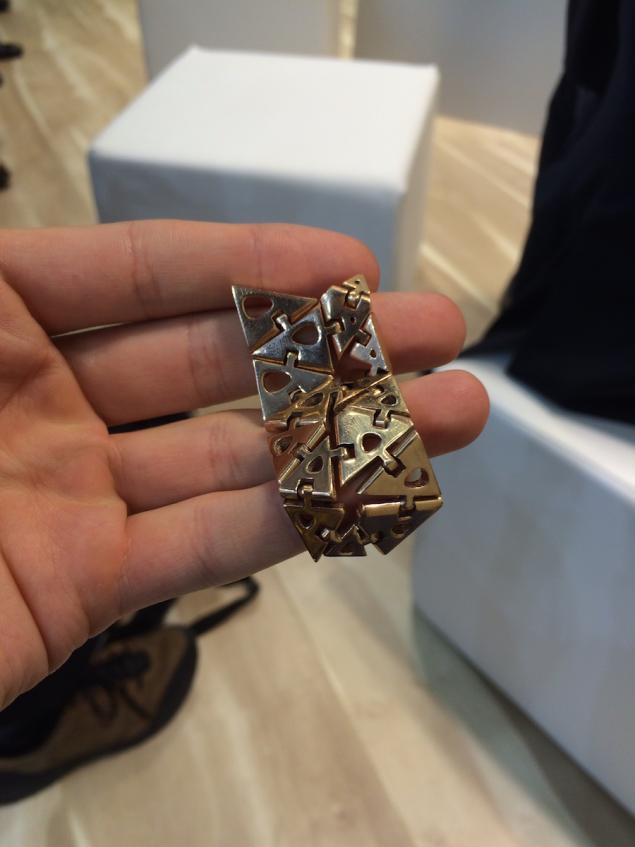
And this is a bracelet with segments. Also printed at a time, inseparable.
All products are made using SLM technology - selective laser melting. The final products require jewelry processing, however, as well as in casting. However, the advantage of the technology offered by Cooksongold and EOS is obvious.
This method of production is suitable for exclusive jewelry, as well as individual products made in batches. 3D printing using this technology will be available on our website in the next few months.
Next, let's talk about ExOne, its technologies allow you to
create two types of products: sand molds for subsequent casting and direct printing from different grades of steel.
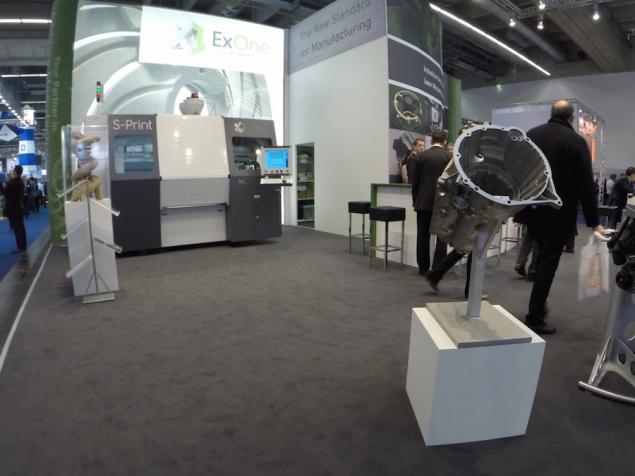
The company is best known for its steel-bronze printing capabilities with a variety of post-processing methods, resulting in highly unusual products.
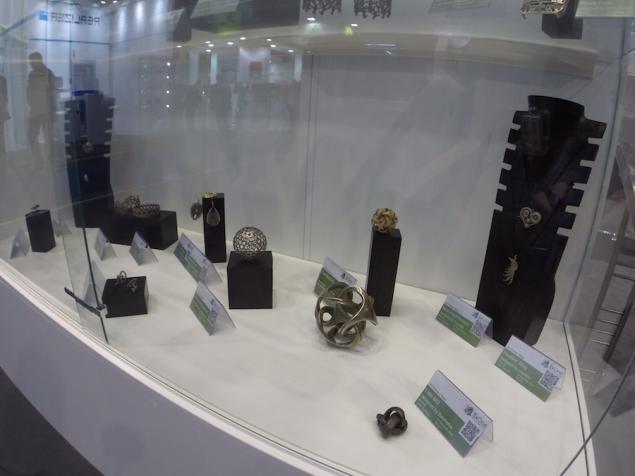
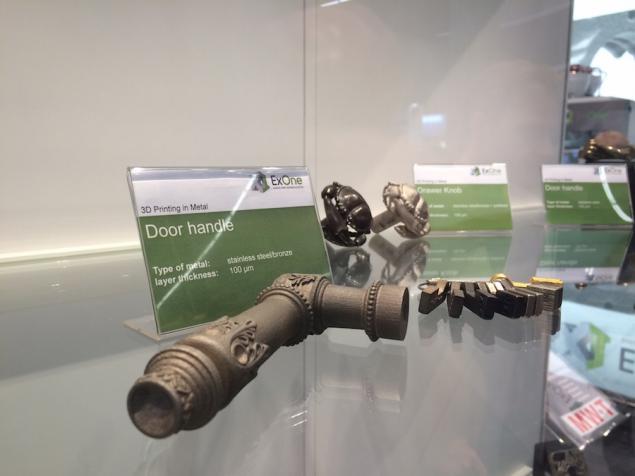
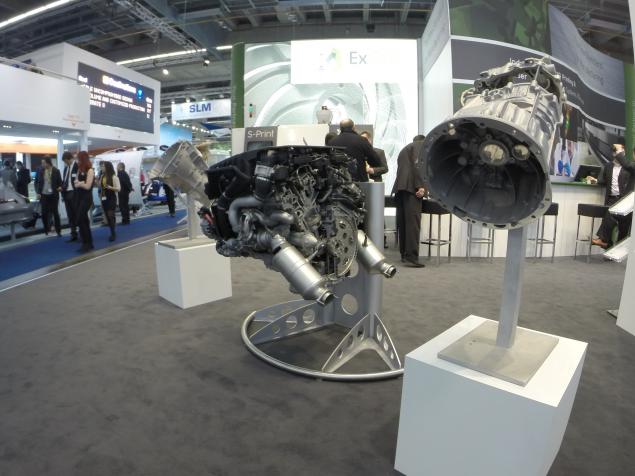
Also, it is impossible not to note the huge contribution of ExOne to the production of sand molds for metal casting. This technology is very actively used in the automotive, aviation and military industries. One example of what the production result of a part looks like after using a burned-out mold is below:
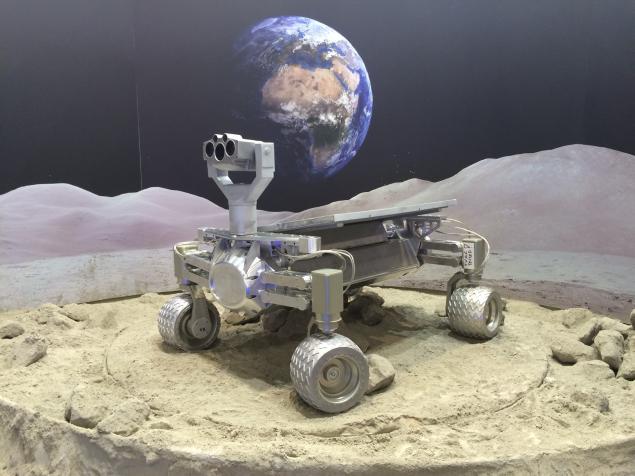
SLM (a manufacturer of metal printers) also distinguished itself. At Euromold, the company demonstrated a printed lunar rover Rover Asimov R3C, which will go to the moon next year!
An overview of all those who contribute to the development of 3D printing would not be complete without briefly telling about Arcam , a manufacturer of industrial 3D printers using EBM (electron beam melting) technology, which allows the production of high-precision titanium products.
The company mainly works for the aerospace and medical (orthopedics) fields. It is its solutions that make it possible to solve the problems of reducing the weight of structural elements of rockets (as an example) and the creation of orthopedic prostheses and inserts adapted to a specific person.
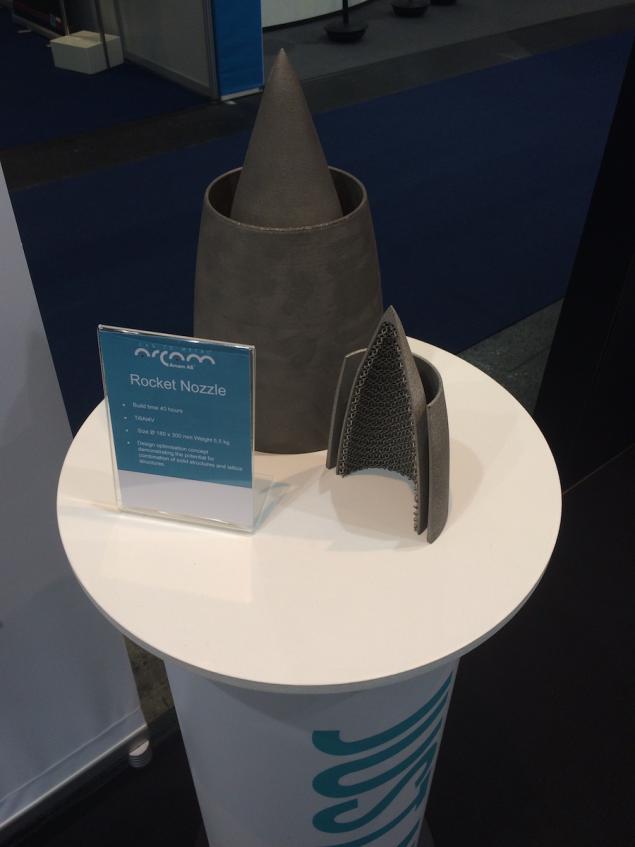
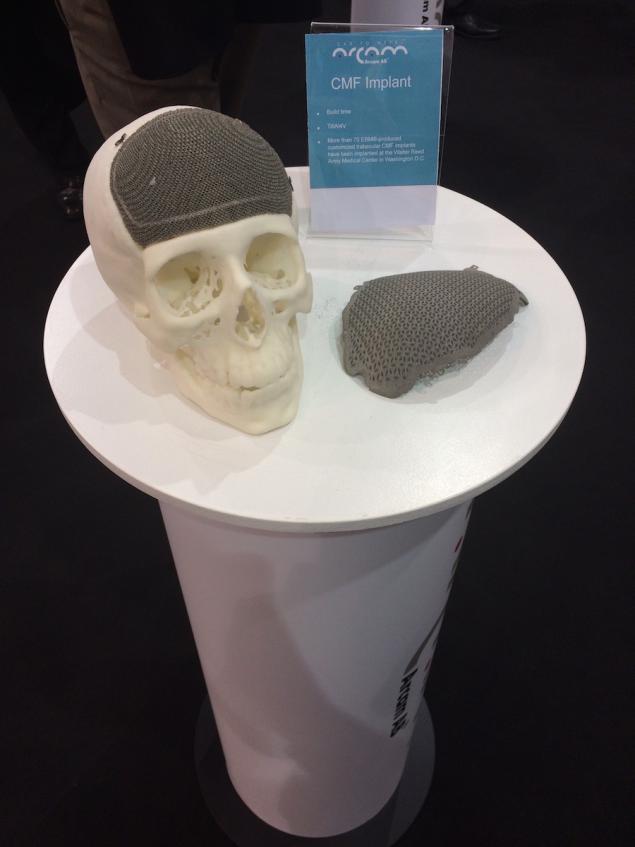
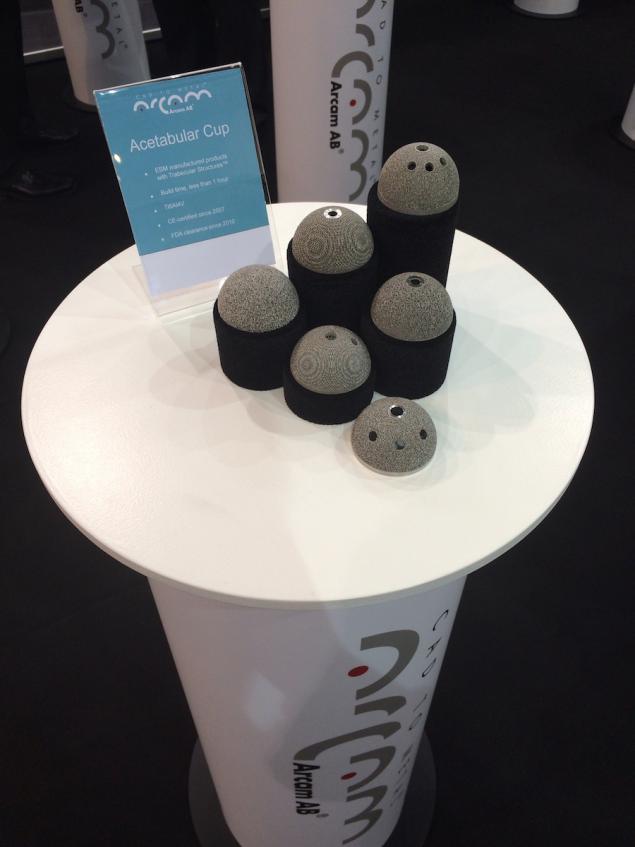
Another very important, but slightly less noticeable player in the additive technologies market is Reninshaw, which presented its new metal printer EVO Project at Euromold.
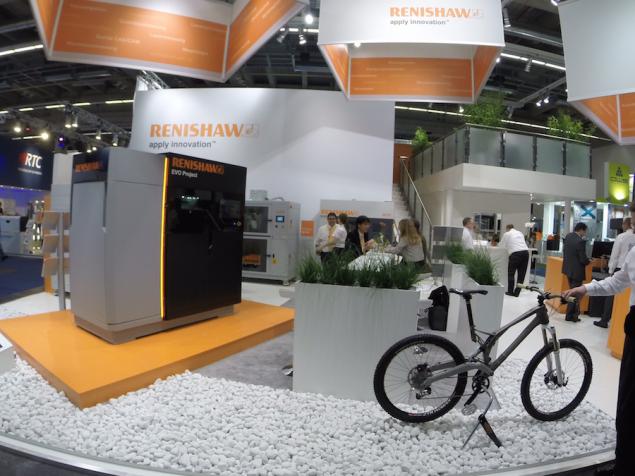
Printer manufacturers place a strong emphasis on full automation of all manufacturing processes and minimal operator intervention. Printing, powder handling, cleaning, recycling – everything is controlled by the printer. At the moment, the printer is tailored for one material. This is a very interesting example of the industry's desire to increase process automation, as this is now a problem.
Those who expected to see the recently announced printer from HP were disappointed. As the printer is still far from perfect, it would be wrong to present it at Euromold.
Rumor has it that the printer uses an old full-color printing technology that was once used by 3D Systems (the pioneer of full-color printing). And the products that are now made on a 3D printer from HP are still very fragile. In general, we are waiting for this printer no earlier than 2016.
Summing up on printers and materials, I would like to once again draw attention to the fact that the areas of application of 3D printing are much wider than it seems at first glance. And the main task now is to reduce barriers to the use of these technologies for businesses and customers.
I am convinced that only transparency and IT systems will help bring all these solutions to the widest possible market. And efforts and money should be invested in the creation of such infrastructures.
Trends
In conclusion of the article, I would like to share my opinion on where the technology is heading, what will change in the near future, and how it will affect the mass adoption of 3D printing in business and various industries.
Automation and conveyor
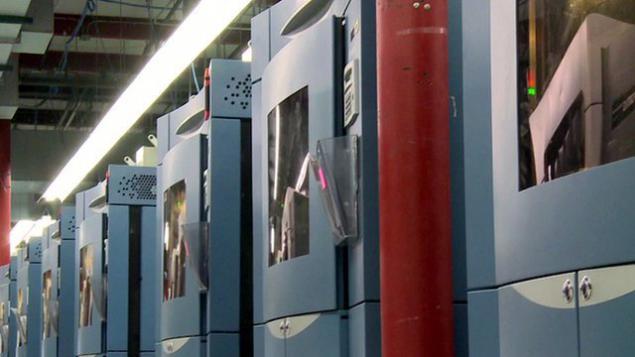
One of the most important trends for the next 2-3 years will be the gradual transformation of industrial 3D printers into automated production systems. Then the efforts of the printer technologist/operator will no longer be focused on constant new loads, cleaning parts, sifting powder, and so on.Instead, a fully automated 3D printer system will do most of the work on its own, without human intervention. This will make it possible to greatly automate the processes that are now done by hand.
This trend is the result of "requests" from such large customers as General Electrics, which requires printer manufacturers to create systems for the production of not single products using 3D printing, but to set up their serial production.
Given the advantages of 3D printing over traditional manufacturing, the ability to mass-produce products will take the technology to a whole new level.
Companies such as 3D Systems, EOS, and Stratasys are actively working with large customers to build such systems.
Optimization
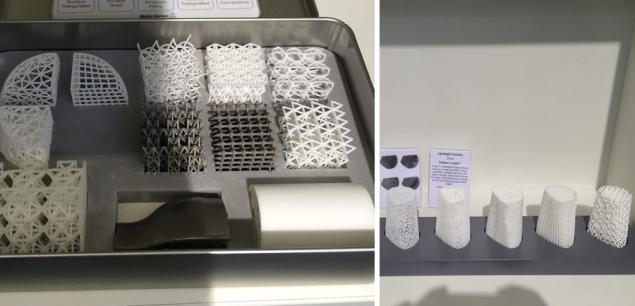
The second important trend is the creation and development of automated software that allows you to optimize the weight, cost, and design of any objects made using 3D printing. Generation of various internal structures (inside the 3D model) allows you to set and change the strength characteristics of products, make them fully flexible, springy, ventilated, and so on.
I would like to note that the implementation of such structures at the level of online software, in the near future, will allow you to avoid mistakes in design, as well as simplify the possibility of optimizing the cost of manufacturing products for customers.
Accessibility
And finally, the most important trend for me and my company is the increase in the availability of additive manufacturing.
Now for us and for many companies in the market, the most important task is to create such online systems that would allow everyone to use all technologies, printers and materials: from private customers to small and medium-sized businesses. In order for this to happen, it is necessary to invest in the automation of many internal processes:
- Instant analysis, fixing and cost calculation
- Production Monitoring and Control
- Automation of material selection and production technologies
In addition, this is constant work to increase the transparency of all processes, access to the resources of specialists in the design and creation of 3D models and, of course, customer service, as the heart of any company.
In my opinion, it is the implementation of all these conditions that will accelerate the pace of development and implementation of technologies in everyday life and work.
I will be happy to discuss any thoughts on the topic with you in the comments!
Source: geektimes.ru/company/3dprintus/blog/242224/
Attack of the drones: six months in the US drones 25 times almost collided with the aircraft
In California, earned the biggest solar power plant in the world