15839
5 facts about the assault on Berlin
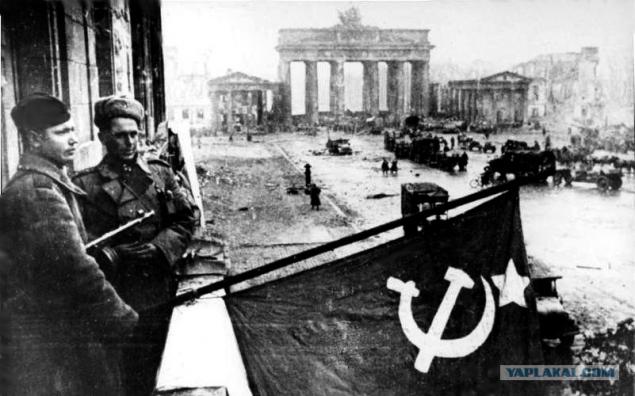
On April 25, 1945, the assault on Berlin began, which became the largest operation during the Great Patriotic War. 3 million people clashed in the battle for the city, where almost as many residents were locked up and starved to death.
1. Record for medals
More awards were given for the assault on Berlin than for all other military operations. About 187 units of the Red Army were awarded honorary "Berlin" titles, which were issued during the Great Patriotic War for the capture and liberation of large settlements. For comparison, there were only 55 "Stalingrad" names.
The medal "For the Capture of Berlin" was awarded to about 1 million 100 thousand people, while the medal "For the Capture of Vienna" was awarded to more than 270 thousand people, "For the Capture of Budapest" 362 thousand, "For the Capture of Königsberg" 760 thousand, "For the Liberation of Warsaw" about 700 thousand, "For the Liberation of Belgrade" - 70 thousand, "For the Liberation of Prague" - 395 thousand.
2. The third capture of Berlin
It is noteworthy that in Russian military history, Berlin became the only capital of a Western European state, which was captured by Russian and Soviet troops as many as three times. It was first taken in 1760 during the Seven Years' War, when the Russian vanguard of General Chernyshev captured the capital of Prussia for several days. Russian troops entered Berlin for the second time in 1813, during the Napoleonic Wars. And finally, Berlin was taken by storm for the third time after heavy fighting on May 2, 1945. For comparison: only once did the armed forces of the Fatherland capture Rome (1799), Paris (1814) and Vienna (1945).
3. In military medicine
The Berlin offensive operation is also remarkable in the history of military medicine. Its feature was the limited evacuation of victims of hostilities from the front line into the depths of the USSR. For example, only 15% of the wounded and sick were evacuated to the deep rear from among the victims of the 1st Ukrainian Front, and the treatment of the rest was carried out in front-line and army medical institutions. The small volume of evacuation was due not only to the difficulties in using railway transport, but also to the fact that the Berlin and Prague operations ended the Great Patriotic War and medical institutions could treat the wounded and sick "on the spot". In addition, during the operation, the Soviet troops suffered small losses in sick people, which made it possible to use most of the hospital beds for the treatment of the wounded.
4. Tank losses
But the technical component of the Red Army suffered greatly. The Berlin operation was associated with serious losses in the composition of Soviet tank units, which were due to the powerful defense of the enemy. In three weeks of fighting, the Soviet side lost about 1800 tanks and self-propelled guns, of which up to 250 were from the use of Faustpatrones by the enemy. Tank units often rushed into the breakthrough where the enemy's anti-tank defense was not suppressed. The actions of tanks in battles for settlements, especially in Berlin, were extremely difficult.
5 "God of War"
The Berlin operation was marked by one of the highest indicators of the density of Soviet artillery in the Great Patriotic War. By 1945, the reduction in the length of the front line and the increase in the production of artillery guns made it possible to use a massive artillery strike to suppress the German defenses at the final stage of the war. Almost the entire front line of the enemy's defense was swept away by heavy artillery fire. Especially large was the concentration of Soviet artillery in the breakthrough areas. Thus, during the Berlin operation, in the breakthrough sector of the 5th Shock Army of the 1st Belorussian Front, there were 347 guns and mortars per 1 km. In total, the three Soviet fronts on April 16, 1945 had 42 thousand guns.
Source: ">