2618
RTG: prosaic heat and electricity for spacecraft

It so happened that in the series «Мирный cosmic atom » we are moving from science fiction to spread. The last time we talked about the power reactors, the obvious next step - to tell about radioisotope thermoelectric generators. Recently Habré was a great post about RTG probe "Cassini» , and we consider this issue from a broader point of view.
The physics of the process Heat In contrast to the nuclear reactor that uses the phenomenon of the nuclear chain reaction, radioisotope generators use natural decay of radioactive isotopes. Recall that atoms are composed of protons, electrons and neutrons. Depending on the number of neutrons in the nucleus of a particular atom, it may be stable or show a tendency to spontaneous disintegration. For example, the cobalt atom 59 Co with 27 protons and 32 neutrons in the nucleus is stable. This cobalt used by mankind since ancient Egypt. But if we add to the 59 Co one neutron (for example, by placing an "ordinary" cobalt in a nuclear reactor), we obtain 60 Co, a radioactive isotope with a half life of 5, 2 years . The term "half-life" means that after 5, 2, one atom splits with a probability of 50%, and from one hundred atoms, will be about half. All the "normal" elements has its isotopes with different half-lives:
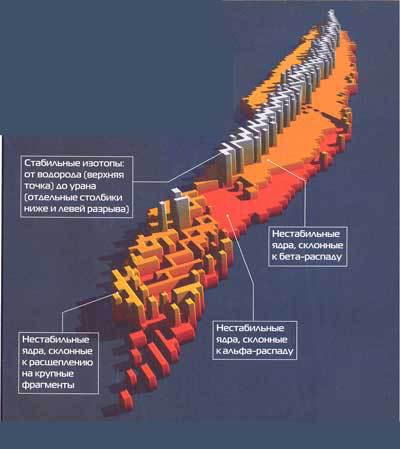
3D map of isotopes, thank LJ user crustgroup per picture.
By selecting a suitable isotope can be obtained with the required RTG lifetime and other parameters:
Isotope The method for producing Power density, W / g Bulk power, W / cc < th> Half-life Integrated energy decay of the isotope, kWh / d Worksheet isotope 60 < / sup> Co (cobalt-60) irradiated in a reactor 2, 9 ~ 26 5, 271 years < / 193, 2 The metal alloy 238 Pu (plutonium-238) nuclear reactor 0, 568 6, 9 86 608 7 90 Sr (strontium-90) fission fragments 0, 93 0, 7 28 years 162 721 SrO, SrTiO 3 144 Ce (cerium-144) fission fragments 2, 6 285 days 57, 439 CeO 2 242 Cm (curium-242) nuclear reactor 121 1169 162 days 677 8 Cm 2 O 3 147 Pm (promethium-147) fission fragments 0, 37 1, 1 2, 64 years 12 34 Pm 2 O 3 137 Cs (cesium-137) fission fragments 0, 27 1, 27 '33 230 24 CsCl 210 Po (poloniy- 210) bismuth irradiation 142 1320 138 days 677 59 alloys with lead, yttrium, gold 244 Cm (curium-244) nuclear reactor 2, 8 33 25 18, 1 year 640 6 Cm 2 O 3 232 U (uranium-232) irradiated thorium 8, 097 ~ 88, 67 68, 9 years old 4887, 103 dioxide carbide, nitride uranium 106 Ru (ruthenium-106) fission fragments 29 8 369 818 ~ 371, 63 days 9, 854 metal alloy
There is a simplified version of the RTG in which the decay of the isotope used for heating, no electricity. Such a module is called a block heating or RHG (Radioisotope Heat Generator).
The conversion of heat into electricity As in the case of a nuclear reactor at the output we obtain heat, which must somehow be converted into electricity. You can use:
- Термоэлектрический converter . Combining the two conductors of different materials (eg, chromel and alumel) and heating is one of them, you can get the source of electricity. Термоэмиссионный converter . In this case, the electron tube. Its cathode is heated and electrons get enough energy to "jump" to the anode, creating an electric current. Thermophotovoltaic converter < / a>. In this case, the heat source connected photocell operating in the infrared range. The heat source emits photons that are detected by photocell and converted into electricity. Термоэлектрический converter on alkali metals . Here, for the conversion of heat into electricity using an electrolyte of molten salts, sodium and sulfur. Stirling engine - thermal Machine for converting temperature difference into the mechanical work. Electricity is obtained from the mechanical work with any generator.
History The first experimental radioisotope power sources was introduced in 1913. But only in the second half of the XX century, the spread of nuclear reactors, which could receive isotopes in industrial scale, RTGs have been actively used.
USA In the United States engaged in RTGs already familiar to you on the previous post organization SNAP.
SNAP-1
This was a pilot on RTG 144 Ce and the generator on цикле Rankine (steam engine) with mercury as a coolant. The generator has successfully worked 2,500 hours in the world, but did not fly into space.
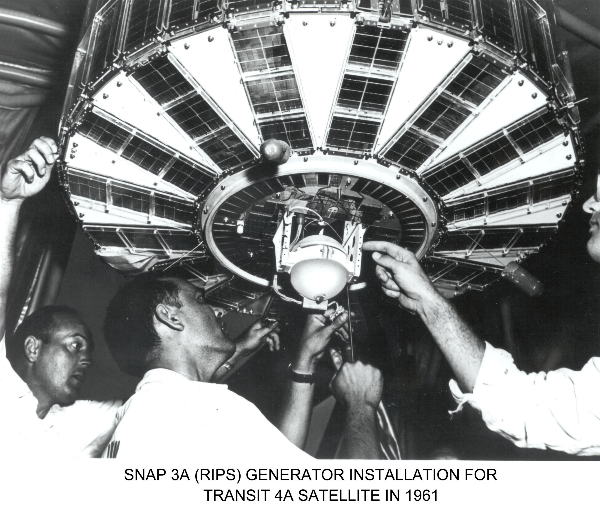
SNAP-3
First RTG fly in space on navigation satellites Transit 4A and 4B. Energy power 2 W, weight 2 kg, used plutonium-238.
Sentry
RTG for meteorological satellites. Energy power 4, 5 W, isotope - strontium-90.
SNAP-7
Family terrestrial RTG lighthouses, light buoys, weather stations, sonobuoys, and the like. Very large models weight from 850 to 2720 kg. Energy Power - tens of watts. For example, SNAP-7D - 30 watts at 2 tons weight.
SNAP-9
Serial RTG for navigation satellites Transit. The mass of 12 kg, the electric power of 25 W.
SNAP-11
Experimental RTG for lunar landing stations Surveyor. Proposes to use isotope curium-242. Electric power - 25 watts. Not used.
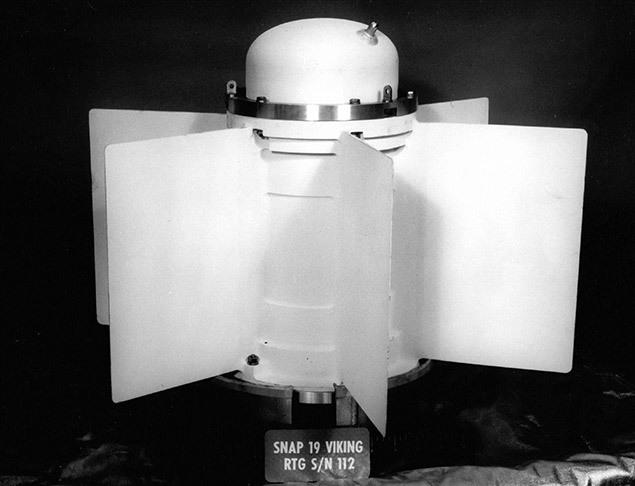
SNAP-19
Serial RTGs used in a variety of missions - meteorological satellites Nimbus, probes "Pioneer" -10 and -11, Martian landing station "Viking". Isotope - plutonium-238 power output ~ 40W.
SNAP-21 and -23
RTGs for underwater use of strontium-90.
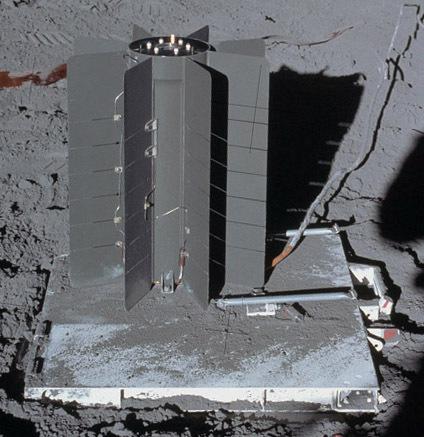
SNAP-27
RTGs to power scientific equipment program "Apollo". 3 to 8 kg. Plutonium-238 was given power output of 70 watts. Lunar scientific equipment has been turned off in 1977 (people and equipment in the world demanded money, and they did not have), and RTGs are still working, and lost only 10% of the initial capacity.
MHW-RTG
The name stands for "mnogosotvattny RTG". 4, 5 kg. Plutonium-238 was given 2400 W of thermal power and 160 watts of electricity. These RTGs were standing on the experimental satellite Lincoln (LES-8, 9) and has 37 years of providing heat and electricity "Voyager". 2014 RTGs provide about 53% of its initial capacity.
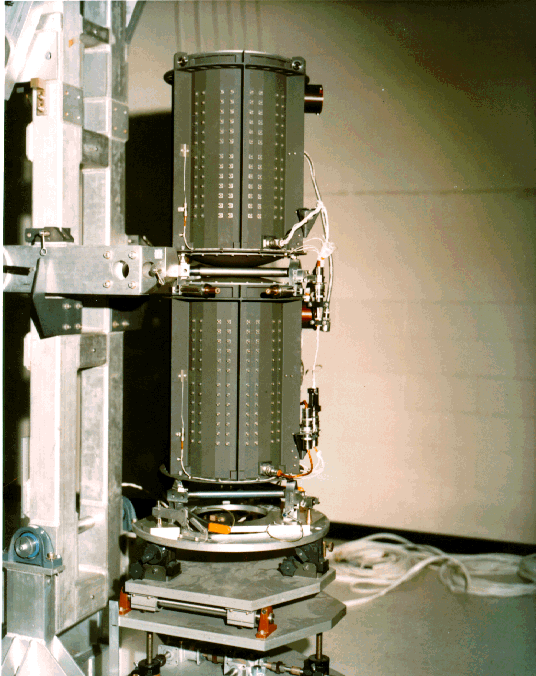
GPHS-RTG
The most powerful space RTGs. 7, 8 kg of plutonium-238 gave 4400 watts of thermal power and 300 watts of electricity. Used on solar probe "Ulysses", the probe "Galileo", "Cassini-Huygens" and flies to Pluto to "new horizons».
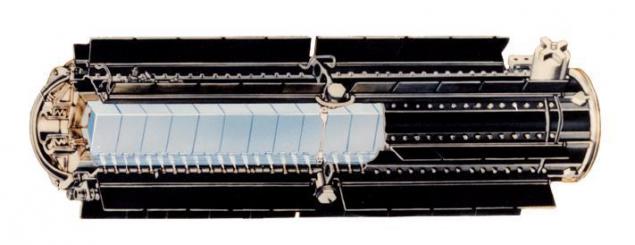
MMRTG
RTG for "Kyuriositi." 4 kg of plutonium-238, 2000 W heating power of 100 W elekticheskoy.
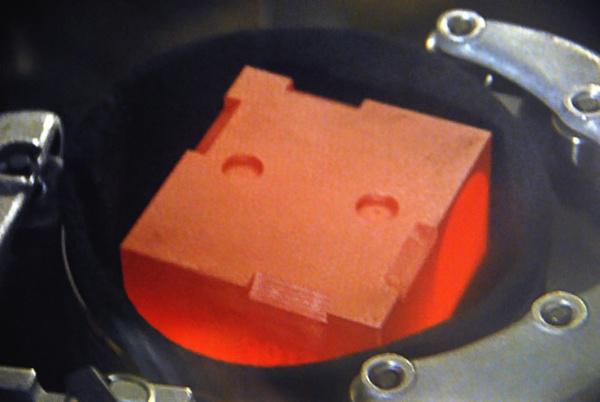
Warm tube cube plutonium.
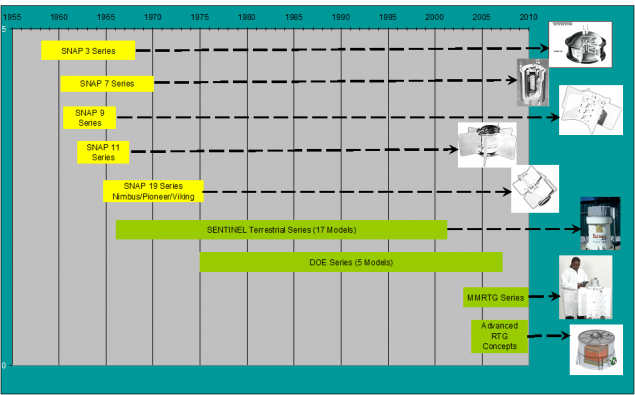
RTGs US-bound in time.
Summary table:
Name Carriers (the number on the unit) Maximum Power Isotope Weight of fuel kg Total weight, kg Electrical, W Heat, W MMRTG MSL / Curiosity rover ~ 110 ~ 2000 238 Pu ~ 4 & lt; 45 GPHS-RTG Cassini (3) , New Horizons (1) , Galileo ( 2) , Ulysses (1) 300 < / 4400 238 Pu 7.8 55.9-57.8 MHW-RTG LES-8/9 , Voyager 1 (3) , Voyager 2 ( 3) 160 2400 238 Pu ~ 4.5 37.7 SNAP- 3B Transit-4A (1) 2.7 52.5 238 Pu ? 2.1 SNAP-9A Transit 5BN1 / 2 (1) 25 525 238 Pu < / ~ 1 12.3 SNAP-19 Nimbus-3 (2), Pioneer 10 (4) , Pioneer 11 (4) 40.3 525 238 Pu ~ 1 13.6 modification of SNAP-19 Viking 1 (2), Viking 2 (2) 42.7 525 238 Pu 15.2 SNAP-27 Apollo 12-17 ALSEP (1) 73 1, 480 238 Pu 3.8
USSR / Russia In the USSR and Russian space RTGs were few. First experimental generator was RTG "Lemon-1" on polonium-210, created in 1962:
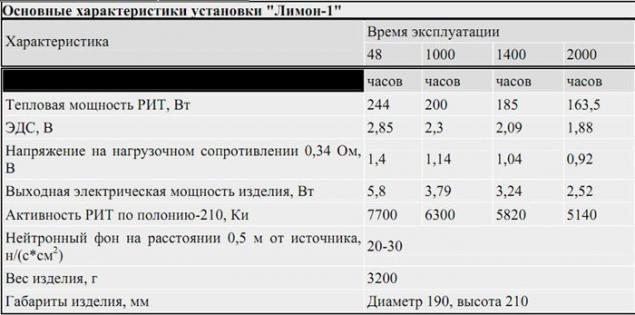
.
The first space RTGs were "Orion-1" electrical power of 20 watts per polonium-210 and running on the connected satellites series "Strela-1" - "Kosmos-84" and "Kosmos-90". Heating blocks stood on the "Lunokhod" -1 and -2, and RTG was on a mission "Mars-96»:
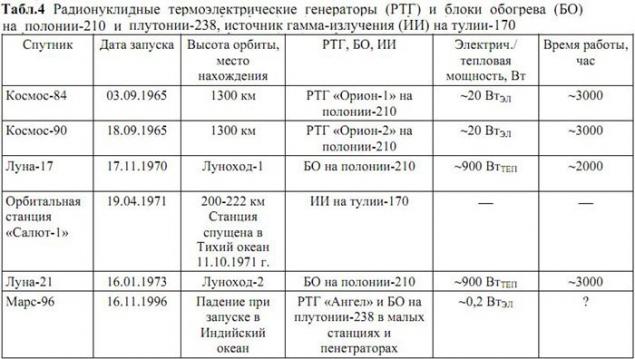
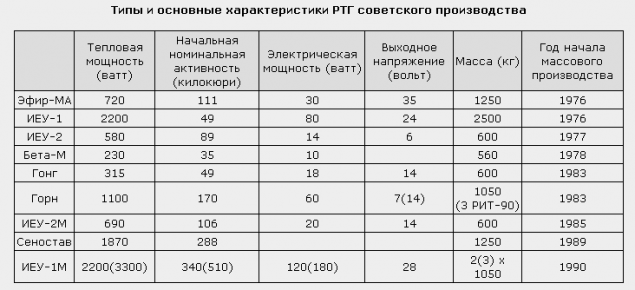
At the same time, the RTGs are very actively used in lighthouses, navigational buoys and other ground equipment - a series of "BETA", "RTG-IED" and many others.
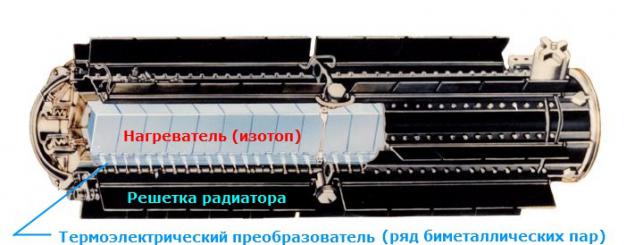
Design Virtually all RTGs use thermoelectric converters, and therefore have the same structure:
Outlook all flies RTGs are very low efficiency - as a rule, the electric power is less than 10% of the heat. So at the beginning of the XXI century in NASA project was launched ASRG - RTG with a Stirling engine. Expected gains in efficiency of up to 30%, and 140 watts of electrical power at 500 watts of heat. Unfortunately, the project was stopped in 2013 due to cost overruns. But, in theory, the use of more efficient converters of heat into electricity can seriously raise the efficiency of RTGs.
Advantages and disadvantages Advantages:
- Very simple design. Can be operated for years and decades, gradually degrading. Can be used both for heating and power. Does not require management and supervision.
- Wanted rare and expensive isotopes as fuel. Fuel production complex, expensive and slow. Low efficiency. The power is limited by the hundreds watts. RTG kilowatt electric power already weakly justified, MW - almost does not make sense: it will be too expensive and heavy.
The combination of these advantages and disadvantages mean that RTGs and heating units have their place in the cosmic energy, and save it to continue. They allow you to easily and efficiently heat and electricity to feed interplanetary spacecraft, but they should not expect any breakthrough energy.
Sources Also used Wikipedia:
- Document «Space nuclear power: opening the last horizon» . Theme «Domestic RTG» "News of Cosmonautics». Отечественные RTGs . Teledyne heritage . RTG online NASA .
Source: habrahabr.ru/post/231197/
Using the principles of psychology to increase conversion sites. Part 5: The effect of facial
Interesting ideas for outdoor recreation

3D map of isotopes, thank LJ user crustgroup per picture.
By selecting a suitable isotope can be obtained with the required RTG lifetime and other parameters:
| Isotope | The method for producing | Power density, W / g | Bulk power, W / cc < th> Half-life | Integrated energy decay of the isotope, kWh / d | Worksheet isotope | 60 < / sup> Co (cobalt-60) irradiated in a reactor 2, 9 ~ 26 5, 271 years < / | 193, 2 The metal alloy | 238 Pu (plutonium-238) | nuclear reactor 0, 568 6, 9 86 608 7 | 90 Sr (strontium-90) fission fragments 0, 93 0, 7 28 years 162 721 SrO, SrTiO 3 | 144 Ce (cerium-144) fission fragments 2, 6 285 days 57, 439 CeO 2 | 242 Cm (curium-242) nuclear reactor 121 1169 162 days 677 8 Cm 2 O 3 | 147 Pm (promethium-147) fission fragments 0, 37 1, 1 2, 64 years 12 34 Pm 2 O 3 | 137 Cs (cesium-137) fission fragments 0, 27 1, 27 | '33 230 24 CsCl | 210 Po (poloniy- 210) bismuth irradiation 142 1320 138 days 677 59 alloys with lead, yttrium, gold | 244 Cm (curium-244) nuclear reactor | 2, 8 33 25 18, 1 year 640 6 Cm 2 O 3 | 232 U (uranium-232) irradiated thorium 8, 097 ~ 88, 67 68, 9 years old 4887, 103 dioxide carbide, nitride uranium | 106 Ru (ruthenium-106) fission fragments 29 8 369 818 ~ 371, 63 days 9, 854 metal alloy
There is a simplified version of the RTG in which the decay of the isotope used for heating, no electricity. Such a module is called a block heating or RHG (Radioisotope Heat Generator). | The conversion of heat into electricity As in the case of a nuclear reactor at the output we obtain heat, which must somehow be converted into electricity. You can use: |
|---|
| Name | Carriers (the number on the unit) | Maximum Power | Isotope | Weight of fuel kg | Total weight, kg | Electrical, W | Heat, W | MMRTG | MSL / Curiosity rover ~ 110 | ~ 2000 238 Pu ~ 4 & lt; 45 GPHS-RTG Cassini (3) , New Horizons (1) , Galileo ( 2) , Ulysses (1) 300 < / | 4400 238 Pu 7.8 55.9-57.8 MHW-RTG LES-8/9 , Voyager 1 (3) , Voyager 2 ( 3) 160 2400 238 Pu ~ 4.5 | 37.7 | SNAP- 3B Transit-4A (1) 2.7 52.5 238 Pu ? 2.1 | SNAP-9A Transit 5BN1 / 2 (1) 25 525 238 Pu < / | ~ 1 12.3 | SNAP-19 Nimbus-3 (2), Pioneer 10 (4) , Pioneer 11 (4) 40.3 525 238 Pu ~ 1 13.6 | modification of SNAP-19 Viking 1 (2), Viking 2 (2) 42.7 525 238 Pu 15.2 | SNAP-27 Apollo 12-17 ALSEP (1) 73 1, 480 238 Pu 3.8
| USSR / Russia In the USSR and Russian space RTGs were few. First experimental generator was RTG "Lemon-1" on polonium-210, created in 1962:  Outlook all flies RTGs are very low efficiency - as a rule, the electric power is less than 10% of the heat. So at the beginning of the XXI century in NASA project was launched ASRG - RTG with a Stirling engine. Expected gains in efficiency of up to 30%, and 140 watts of electrical power at 500 watts of heat. Unfortunately, the project was stopped in 2013 due to cost overruns. But, in theory, the use of more efficient converters of heat into electricity can seriously raise the efficiency of RTGs.
|
|---|
