11853
Important to know: Compatibility of vitamins and minerals
Which vitamins and minerals are and are not combined with each other?
Our body is like a chemical factory, in which many different processes take place at the same time. All these processes require a variety of elements that we get from the outside - proteins, fats, carbohydrates, vitamins and minerals.In order for all these substances to be absorbed and optimally used by the body, it is important to know which substances combine with each other and which do not. Some vitamins and minerals interfere with the absorption of each other, while others, on the contrary, help. Moreover, some vitamins and minerals cannot be absorbed and used by the body individually at all.
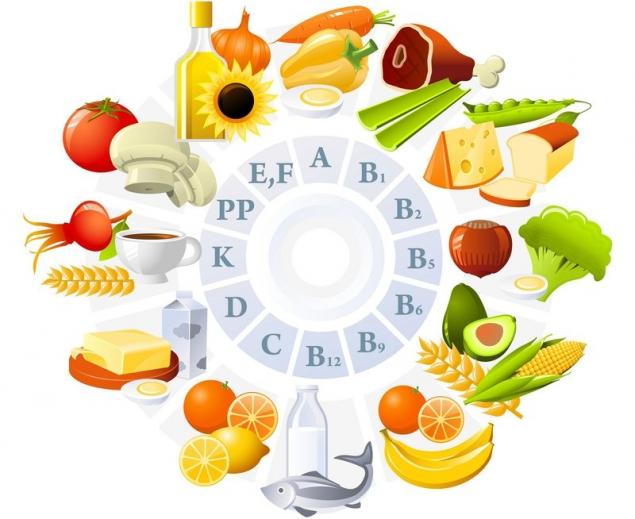
Let's see how the most common vitamins (A, B1, B2, B3, B5, B6, B9, B12, C, D, E, K) and minerals (iron, magnesium, manganese, copper, calcium, silicon, selenium, phosphorus, zinc) are combined.
Good compatibility of vitamins and minerals
What vitamins and minerals are combined?Simultaneous intake of vitamins and minerals that are well combined with each other gives an effect that is many times higher than the effect of taking them separately. Synergy is exactly the case when 2 + 2 = 10, not 4.
The reasons can be different:
- Vitamins and minerals can interact in storage or already in the stomach to help absorb each other (pharmaceutical interaction).
- Vitamins and minerals can enhance each other's effects by participating in the same processes in the body (pharmacological interaction).
Vitamin A (retinol)
Good compatibility with vitamins C and E and minerals, iron and zinc.- Vitamins C and E protect vitamin A from oxidation.
- Vitamin E improves the absorption of vitamin A, but only if there is little vitamin E. A large amount of vitamin E, on the contrary, interferes with the absorption of vitamin A.
- Zinc improves the absorption of vitamin A by participating in its conversion in the retina of the eye.
- Vitamin A improves the absorption of iron and allows the use of the iron stored in the liver.
Vitamin B2 (riboflavin)
Good compatibility with vitamins B3, B6, B9 and K and with the mineral zinc.- The conversion of vitamins B3, B6, B9 and K into the active form occurs with the participation of vitamin B2.
- Vitamin B2 increases the bioavailability of zinc.
Vitamin B3 (PP, nicotinic acid)
Good compatibility with iron, copper and vitamins B2, B6 and H.- Copper and vitamin B6 improve the absorption of vitamin B3.
VitaminB5 (pantothenic acid)
Good compatibility with vitamins B1, B2, B4, B9, B12 and C.- Vitamins B1 and B2 significantly improve the absorption of vitamin B5.
- Vitamin B5 facilitates the absorption of vitamins B4, B9 and C.
Vitamin B6 (pyridoxine)
Good compatibility with vitamin B2 and with the minerals copper and zinc.- Vitamin B2 helps vitamin B6 to turn into its active form, while magnesium improves its ability to enter cells.
- Vitamin B6 reduces the loss of zinc in the body.
Vitamin B9 (folic acid)
Good compatibility with vitamin C.- Vitamin C preserves vitamin B9 in the tissues of the body.
Vitamin B12 (cyanocobalamin)
Good compatibility with vitamins B5, B9 and calcium.- Calcium helps the absorption of vitamin B12 in the body.
Vitamin C (ascorbic acid)
Good compatibility with vitamins A, E, B5 and B9.- The antioxidant effect of vitamin C is enhanced by carotenoids, vitamin E and flavonoids.
- Vitamin C restores the activity of vitamin E.
- Vitamin C contributes to the preservation of vitamin B9 in tissues.
- Vitamin C aids in the absorption of calcium and chromium.
Vitamin D (calciferol)
Good compatibility with calcium and phosphorus.- Vitamin D improves the metabolism of phosphorus and calcium in the body.
Vitamin E (tocopherol)
Good compatibility with selenium and vitamin C.- Selenium enhances the antioxidant effect of vitamin E.
- Vitamin C restores the functions of vitamin E during oxidation.
Vitamin K
Good compatibility with calcium and vitamin B2.- Vitamin K helps calcium build bone tissue in the body.
- Vitamin B2 is necessary for the conversion of vitamin K into its active form.
Calcium
Good compatibility with magnesium, boron and vitamins B6, B12, D and K.- Such a vitamin and mineral complex (calcium, magnesium, boron and vitamins B6, B12, D and K) ensures the best absorption of calcium and reduces its loss by the body. There should not be an excess of magnesium, otherwise the result will be the opposite.
Iron
Good compatibility with copper and vitamins A, B3 and C.- Copper and vitamins A and C improve the absorption of iron.
Phosphorus
Good compatibility with vitamin D.- Vitamin D improves the absorption of phosphorus.
Copper
Good compatibility with vitamin B6 and iron.- Copper in small quantities contributes to the absorption of iron.
Magnesium
Good compatibility with calcium and B vitamins (except B1).- Magnesium promotes the absorption of B vitamins (except B1) and calcium.
Zinc
Good compatibility with vitamins A, B2 and B6.- Zinc improves the absorption of vitamin A by participating in its conversion in the retina of the eye.
- Vitamin B2 increases the bioavailability of zinc, and vitamin B6 prevents the body from losing zinc.
Poor compatibility of vitamins and minerals
Which vitamins and minerals do NOT go together?In some combinations, vitamins and minerals can destroy each other or depress each other's properties. It is advisable to take such vitamins and minerals separately, with a break of 4-6 hours.
Vitamin B1 (thiamine)
Poor compatibility with vitamins B2, B3, B6 and B12 and the minerals magnesium and calcium.- Excessive use of vitamin B1 is dangerous in itself, due to frequent allergic reactions. Taking vitamin B1 with vitamin B12 together can increase the allergic reaction.
- Vitamins B2 and B3 completely destroy vitamin B1.
- Vitamin B6 inhibits the transition of vitamin B1 to a biologically active state.
- Magnesium and calcium interfere with the absorption of vitamin B1, significantly reducing its solubility in water.
Vitamin B2 (riboflavin)
Poor compatibility with the minerals iron and copper.- Iron and copper slow down the absorption of vitamin B2.
Vitamin B5 (pantothenic acid)
Poor compatibility with copper.- Copper reduces the activity of vitamin B5.
Vitamin B6 (pyridoxine)
Poor compatibility with vitamins B1 and B12.- Vitamin B6 inhibits the transition of vitamin B1 into the active form.
- Vitamin B12 contributes to the breakdown of vitamin B6.
Vitamin B9 (folic acid)
Poor zinc compatibility.- Zinc and folic acid (vitamin B9) together form an insoluble complex, which impairs the absorption of both.
Vitamin B12 (cyanocobalamin)
Poor compatibility with iron, manganese, copper, and vitamins A, B1, B2, B3, B6, C, and E.- Under the influence of iron, manganese and copper and vitamins A, B1, B2, B3, B6, C and E, vitamin B12 becomes inactive.
Vitamin C (ascorbic acid)
Poor compatibility with B1, B12 and copper.- When a person takes vitamin C, B12, copper, vitamin B1 in different tablets and at different times, the maximum of their concentration in the blood is reached, which reduces the possibility of developing a negative interaction.
- An overdose of vitamin C leads, among other troubles, to the leaching of copper from the body.
Vitamin E (tocopherol)
Poor compatibility with magnesium, zinc, copper, and vitamin D.- To boost the absorption of vitamin E, it should be consumed separately from magnesium, zinc, copper, and vitamin D.
Vitamin K
Poor compatibility with vitamins E and A.- Vitamins E and A prevent vitamin K from entering cells.
Calcium
Poor compatibility with sodium, iron, phosphorus, manganese, zinc, as well as with excess magnesium.- Large amounts of magnesium, iron or phosphorus lead to calcium deficiency.
- Calcium, in turn, interferes with the absorption of these minerals.
Iron
Poor compatibility with zinc, magnesium, chromium and calcium and with vitamins E and B12.- Zinc, magnesium, chromium and calcium interfere with the absorption of iron.
- Iron interferes with the absorption of vitamins E and B12, calcium and manganese.
Phosphorus
Poor compatibility with magnesium and calcium.- Excess magnesium and calcium leads to phosphorus deficiency in the body.
Copper
Poor compatibility with zinc and with vitamins B2, B5, B12, C and E.- Copper interferes with the absorption of vitamins B2, B5, B12, C and E.
- Copper also interferes with the absorption of zinc.
- In large quantities, copper impairs the absorption of iron, although in small quantities, on the contrary, it has a beneficial effect.
Manganese
Poor compatibility with calcium and iron.- Calcium and iron impair the absorption of manganese.
Magnesium
Poor compatibility with vitamins B1 and E, phosphorus and manganese (in large quantities - also with calcium).- Magnesium impairs the absorption of vitamins B1 and E.
- Phosphorus and manganese impair the absorption of magnesium in the body.
- An increased amount of magnesium leads to a deficiency of calcium and phosphorus.
Zinc
Poor compatibility with vitamin B9, calcium, iron, and copper.- Calcium, iron and copper prevent the body from absorbing zinc.
- Zinc and vitamin B9 together form an insoluble complex, which impairs their absorption.
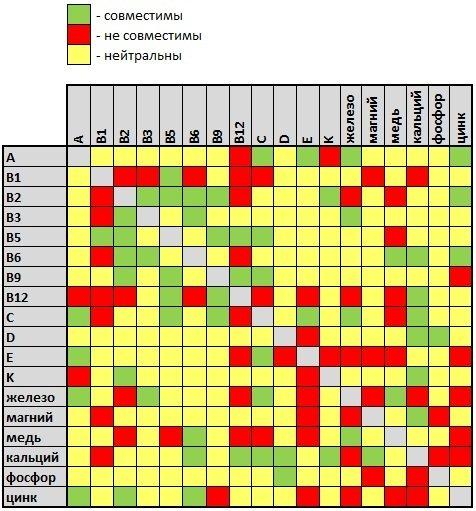
Table of compatibility of vitamins and minerals
For convenience, I have compiled this compatibility table of the most common vitamins and minerals. Using the table is very simple:- Green indicates good combinations of vitamins and minerals, which work well together to help absorb each other and/or enhance the effect.
- Unfortunate combinations that should be avoided are marked in red. The effect of taking these vitamins and minerals together will be minimal or negative. They should be taken separately, with a break of 4-6 hours.
- Neutral combinations are marked in yellow. These vitamins and minerals can be consumed together or separately.
In addition to the compatibility of various vitamins and minerals with each other, it is desirable to take into account the effect of products. Vitamin and mineral complexes are only an additive to your main diet, which also contains biologically active substances. This influence is not always favorable.
Here are the main factors that can significantly worsen the result of taking vitamins and minerals:
Some foods impair the absorption of vitamins and minerals or provoke their loss. These are caffeinated beverages (coffee, black and green tea), milk and dairy products. If possible, try to avoid eating these foods or at least reduce their amount. At the very least, you should not combine their use with the intake of vitamins and minerals - wait 4-6 hours so that the nutrients have time to be absorbed in the body. Many of the substances we need are produced by the beneficial bacteria that live in the gut. For optimal absorption and use of vitamins and minerals entering the body, a healthy microflora is needed. If you eat meat, eggs, dairy products, then most of your beneficial bacteria are replaced by putrefactive bacteria. To restore the gut microflora, reduce the amount of animal products and increase the proportion of fresh plant foods - this is the food that is preferred by beneficial bacteria. Also, antibiotics have a detrimental effect on the microflora. Stress also kills some beneficial bacteria (more precisely, adrenaline, which enters the intestines due to the fact that we do not use it during stress – we do not run, do not fight, but sit and worry). Therefore, after taking antibiotics or severe prolonged stress, you should always take a course of probiotics. Your vitamins and minerals can eat... vermin. 90% of the population is infected with parasites. It is almost impossible to avoid infection. The paradox is that all of the above factors are usually the main reason why you do not get vitamins and minerals from food and are forced to take them in the form of pills. published
Author: Inna Dubson
P.S. And remember, just by changing your consciousness – we change the world together! ©
Source: //health4ever.org/vitaminy-i-mineraly/sovmestimost-vitaminov-i-mineralov