2004
Basic English prepositions. What to learn in the first place!
This part of the speech as prepositions in the English language plays a significant role, and sometimes works wonders. Joining the verbs, prepositions dramatically change their meaning, preceding a noun, urged them on cases, the objects move in space, indicate their location and more. Skillful use of prepositions - real mastery. Therefore, I put together the most basic of English prepositions and rules of their use.
at 1. Position (at, at a certain point)
2. The time (in hours)
She is at school.
She is sitting at my table.
Let us meet at 5 p.m.!
in 1. Location (in a separate space)
2. The time (months, years)
3. The work, written in some language
He is in the study.
The book is in my table.
Summer begins in June.
It took place in 2002.
This article is written in English.
on 1. Position (horizontal and vertical surface)
2. Initiate anything on the topic (about about)
3. Time (days)
The book is on my table.
The picture is on the wall.
This is an article on history.
I was born on the 5th of November.
from 1. The direction (of, from)
2. Time (with, from)
The train is coming from Moscow.
Take the pencil from the table.
I'll be busy from 10 a.m.
to 1. direction (at)
2. The time (up to a certain point)
3. Meets dative
We came to Moscow.
They went to the theatre.
I'll be busy from 10 pm to 3 pm
Give this book to me.
since Time (from, to a certain point)
I'll have a rest since July till August.
till Time (up to a certain point)
Till Friday I'll be very busy.
into Direction (inside)
Put the book into the bag.
onto Direction (on the surface of something)
Put the pen from the drawer onto the table.
before Time (prior to)
The accident took place before our era.
after Time (after)
I went there after the stopped.
about 1. (relatively)
2. Place (around, around, around)
3. Time (approximately approximately)
Please, tell me about him.
Come about 2 p.m.
It was about noon, when she came home.
for 1. Time (within a specified - in days, years - a period of time)
2. Target (on)
Z. For
4. Destination (c) with the verb to leave
I have lived there for two years.
I went for a walk.
That is a present for you.
We left for St. Petersburg at 10 p.m.
during Time (for a period of time expressed noun)
I was in the countryside during my weekend.
of 1. Meets the genitive (what ?, who?)
2. (relatively)
All the students of this group passed the eams perfectly.
You must never think of him badly.
with 1. Meets ablative (what?)
2. together
3. From (surprise, fear)
We write with pens.
He went to the station with her.
His face was pale with fear.
by 1. Meets ablative (by whom?)
2. Place (near, close)
3. Time (for some time)
This poem was written by Pushkin.
He was standing by the window.
He had already come by 3 p.m.
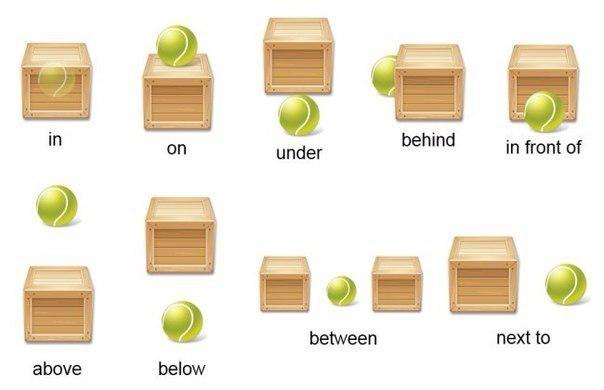
between Location (between two objects)
The father divided the apples between his two sons.
among Location (between multiple objects or objects)
The farther divided the apples among all his children.
ecept (for) Additionally (except for those present)
Everybody likes it ecept me.
besides In addition (in addition, the number of longer present)
There were five boys in the room besides me.
over Above, above via, for, in, for (period)
A flight over the lake - a flight over the lake.
Over the last five years - in the last five years.
below Below the
Below zero - below zero.
out Outside, outside, outside
My crossbow is already out.
behind Rear, behind
The sun is behind a cloud.
The ability to set prepositions can tell a lot about your language level, so hurry up to save itself this cheat sheet and learn the rules by heart, to improve my English. And help is to make your friends telling about this article!
via takprosto cc
25 bright ideas for summer manicure. Add zest to your image!
9 tricks for a perfect hairstyle. Turn into well-groomed beauty for a couple of minutes!