1409
The work of underwater archaeologists
I must say that underwater archeology has very little to do with what is shown in films. Most often, the work begins in archives and occupies 90 percent of the time. Once found the treasured record of the lost ships, a team of archaeologists out to sea and scanning the bottom of the side-scan sonar trying to find the object. Often they find another ship or nothing do not find.

By the way, our ship RC-311 which we went into the sea.

Once the ship is found, the fun begins. A team of divers dives and tries to identify the ship. Make it not so easy - despite the fact that the Baltic Sea, the safety of objects is very high (due to the low salinity, there is little worm, woodworm) often immediately understand what this pile of boards is not possible. Rare case when the ship was identified immediately: sailing screw frigate "Oleg" zatonuvshiyv 1859 during a training exercise.

Helm. It is a double and duplicated on a bridge. We twist it 4 sailor.

Anchor spire. On the curbstone manually wind the anchor rope.

Unfortunately, most of the ship is decomposed into its constituent parts and looks like this:
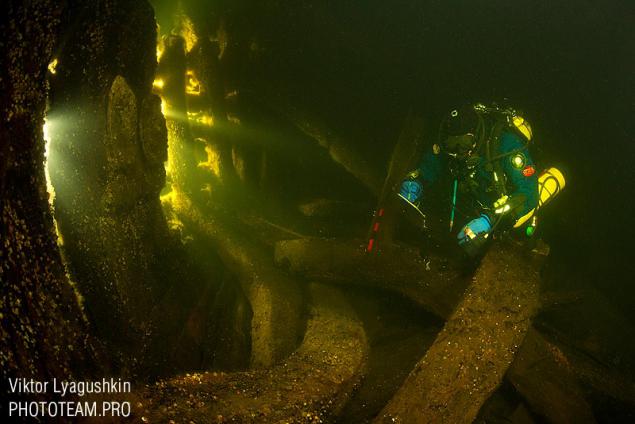
Or this: it will fall off the board from the side and deadeye that photographs archaeologist Roman Prokhorov.

Once it became clear that at the bottom of a pile of boards - it is not known that start painstaking work on the subject. It must measure and photograph, to try to identify the size of typical add-ins, armed itditd.
For example, measured by seat nasal area.

Videographers on the markup.

This marking beams for the sounding board.

Most on board are typical items, which can identify the ship. The bow of the schooner Louise figure sank in 1836, decorated with gold 8)

Three-funt gun barque Tobias sank in 1740.

Cheek carriage transport "America" sank in 1859.

Anchors.

Pottery, which is to determine the hallmarks year of creation.


And bottles (sometimes with contents sometimes not)
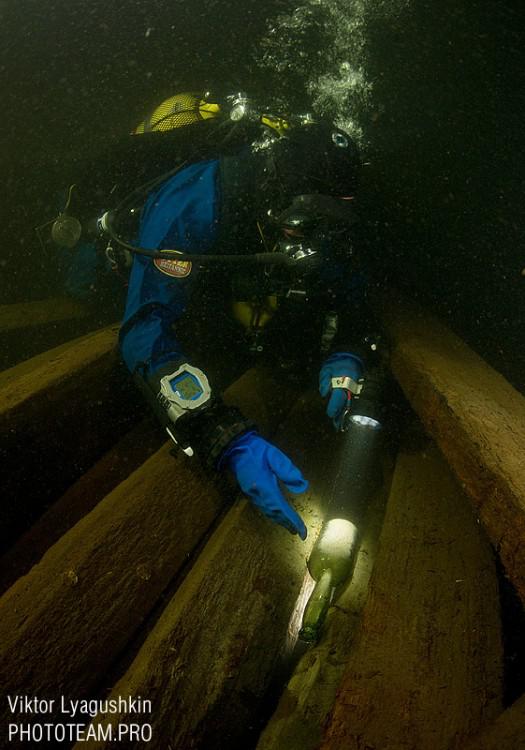

If the surface does not lie, we have to dig:

Here archaeologist Ivan Galaida found shtaf-deadeye transport America.

Well, certainly it is necessary to sketch and photograph all.

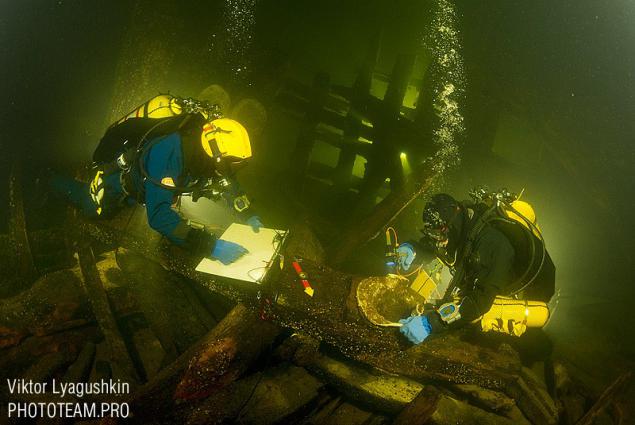
Paintings on plastic plates pencils. Before that the touch - photographed or videotaped, so that you can later remember how everything was. Here's an example sketch transport "America».

The main danger in archaeological work - possibility of losing the high seas and entanglement that occurs frequently. Therefore, work as a team to be able to help each other.


Baltic sea - very complicated and ships sank here permanently. Therefore, almost no where to Dive - lie the remains of ships.

If you swim in shallow water with a mine detector is sure to find shmurdyak from the war.


Anti-aircraft gun:

Sometimes there are very interesting findings and detective stories. Historian Andrew Lukoshkov opened case of theft of 4,000 bales of skin when he found a ship "Archangel Raphael" sunk in 1724. Menshikov tried to bring a large smuggling from St. Petersburg to Germany, but not the captain calculated the weather and the ship was crushed by ice.

In the hold, we found three barrels of lard 1724 release! visible in the photo.

And the barrel of whole grain.

All we sent for examination. One of the interesting ships - Swedish ship that had not yet been identified. He was killed during the battle Vyborskogo near Birch Island. On board the four foot skeleton of a sailor and a gun beside her. Probably never resigned.

From cool finds, here is a table set of captain's cabin of the frigate Oleg. The bottles are preserved and salt and pepper and vinegar.

Dutch sailors tube

A collection of bottles. In fact, the bottles are typical for their time and are important for identification. It was a one-time thing is not as it is now, and they served a long time.

Dutch porcelain.

The handle of the sword from the battleship Gangut.

Here's a very cool thing - one of the world's first hand wheels (or rather the helm of the first type). 16th century.

Source: samebody.livejournal.com