1721
The future for 3D-sound
47,867,040
Modern audio technology can radically change our understanding of computer games, music and movies
I can not believe my ears. I took an ordinary gray cube around the head and was ready to swear that hear of it instrumental music is heard - as if it was a tiny speaker. The sounds of the violin suddenly became very loud when the cube is close to your ear and calmed down when he drew back away.
If the cube was placed behind me, it seemed that I turned my back to the string quartet. When I spent a cube over his head on it ran shivers, and it seemed that music plays from above. But by itself is silent cube. Music could be heard through the headphones, and when I took them off - all the illusion disappeared.
I'm in the big room IT-incubator of the University of Maryland, where a team of a startup VisiSonics, consisting of eight people. It was they who created the software which held my brain, causing him to hear 3D-sound through headphones. Grey cube, which I hold in my hand, is connected to a device to monitor its location relative to my head.
Technology RealSpace 3D, developed VisiSonics, uses spatial data from the tracking system to process music, so it seems as if it was coming from the cube. This demo simply shows that designed software capable of actually trick your brain - is strikingly what I had completely forgotten about the headphones.
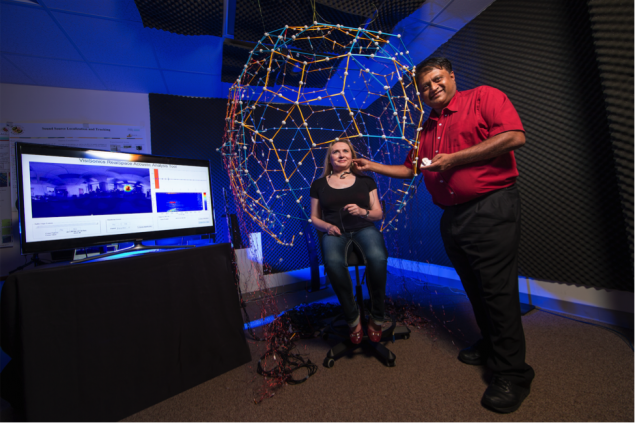
Research Ramani Duraisvami (Ramani Duraiswami) helped him to create software that accurately reproduces the 3D-audio through headphones. Accurately reproduce 3D-audio can be by measuring individual characteristic transfer function of a so-called head (HRTF), which normally takes 2-3 hours. The prototype developed Duraisvami, which sits Zotkina Elena is able to measure the HRTF for a few tens of seconds,
This effect, which in VisiSonics have high expectations. The company hopes to develop audio engine for games, which will be used to create a virtual or augmented reality. I can say that the technology has already made a big step in that direction. Oculus VR, not so long ago bought Facebook, last October, has licensed for its RealSpace 3D head-mounted display Oculus Rift, and made it to the list of development tools audio software Oculus.
VisiSonics also negotiating with other companies. "The goal for 3D-sound great - make listening to music through earphones you thought that you do not have them", - says Ramani Duraisvami, one of the founders and a teacher computer science at the University of Maryland in College Park.
But the company does not intend to stop at the video games and virtual reality. "Where people use headphones - we'll be there to completely change their view of the sound," - added Duraisvami.
We perceive our ability to hear the sound in three dimensions for granted - even with your eyes closed, we can determine the position of the sound source. The brain interprets the sound is surprisingly good coming into our ears, which act as a spatially separated microphones. This means that it uses a different signal parameters such as the delay between receipt of it in right and left ear, to determine on which side the sound is coming. Repeat this effect with the use of headphones is not easy.
To achieve the effect for 3D-sound can be simply arranged around a large number of speakers. This approach is used by many theaters, but with headphones, this trick does not work out. The flourishing of mobile devices means that many of us are playing computer games, listening to music and watching movies, using headphones and software VisiSounds can play 3D-sound from any device.
Imagine how you listen to Beethoven's 9 on your mobile, and you feel that you are sitting in the best seats in the theater, listening to a live performance. Or imagine the horror while watching on your iPad, you suddenly begin to hear the footsteps of the villain right behind her.
One of the first demo, which created Haxton Rod (Rod Haxton), to show the possibilities of technology RealSpace 3D
Engineers have tried to reproduce the effect for 3D-sound for a century. Most of this time the scientists used a dummy head with a microphone in each ear for sound, trying to create a model of a human head.
VisiSonics found a way to get rid of the dummy and now use the software. We determine the source of the sound, turning your head in different directions. In a virtual or augmented reality, it is important not only to pinpoint the source of the sound, but plausible enough to change the sound depending on the position of the head. When you turn your head, VisiSonics software calculates in real time the parameters of the sound changes - this creates the effect of full immersion.
The software also takes into account the features of the room, determine the behavior of sound in space. You hear not only the sound but also its multiple reflections from the walls, furniture and other things in the room. Sound reverberation occupy last place in the determination of the distance between the person and the sound source and the transfer of feelings of distance. According Duraisvami, it is the precision with which the software recreates the reverberation and makes it sound so natural RealSpace 3D.
The third important component of software Duraisvami - is the ability to recreate how sound interacts with your body, even before it enters the ear canal. Sound differently reflected from the head, body and bends of the outer ear, depending on the source position. Scientists describe this feature of the transfer function of the head or HRTF (HRTF - head-related transfer function). If you want to accurately recreate the sound coming from a certain direction, then you have to take into account the HRTF.
Although the sound is processed VisiSonics, comes from the headphones, my brain sure that it goes gray cube, which I hold in my hand. «3D-sound - a" three-legged stool "- says Duraisvami. - If you remove one leg, then it will fall ».
With these advances in 3D-audio any music, movie or game can play a sound as if you really are in an open field, a cozy room or concert hall. You can release music and movies from the very beginning supported 3D-audio.
For example, Björk has recently released a panoramic musical clip with 3D-sound (the technology used in the video, it has been developed among the competitors VisiSounds). Singer on his page on Facebook to describe the feeling of watching a clip: "You seem to be on the beach and around you dense sit around 30 musicians." STUDIO , trying to capture panoramic movies with immersive, where all the action is happening right around you, this technology will need everything to be the most plausible.
Over the past decade the visual component of virtual reality has made a big step forward, but audio begins to "catch up" just now - and just in time, as several companies have recently announced (or have already released) new headset. "You can not and should not be" immersed "in virtual reality by half" - grins Duraisvami.
Another demo opportunities RealSpace 3D, prepared by an independent developer with plugins VisiSonics, helped me to understand why you need Oculus 3D-audio. When I first put on a head-mounted display, I immediately wanted to dissolve in it.
I was standing on a wooden bridge over the river, and grew up around the tropical trees. I turned his head to see lush vegetation of the world - a feeling similar to the study of the rich environment of computer games, but in this case you just feel like a part of it, and this feeling is reinforced with sound RealSpace 3D. I stood under the open night sky around chirping crickets, and on my right out of the chimney Flowing water stream. When I turned my head to get a better view landscape, the sound changes as needed, keeping the full sense of reality.
On «Kickstarter» began collecting money for the children's designer to build drones
Overview of electric bikes, trucks for geeks