11707
Stars as we don't see them
I know that a huge proportion of the audience of this resource is specialists in various fields of science.
But I also know that it is visited by a lot of people who are simply interested in natural phenomena (I consider myself to be of this type), which does not detract from their desire to know the Universe as much as imagination and patience allow!
Therefore, this article aims to entertain and, possibly, push someone to a deeper study of the issue, as well as, simply, to introduce a new vision and representation of seemingly familiar things.
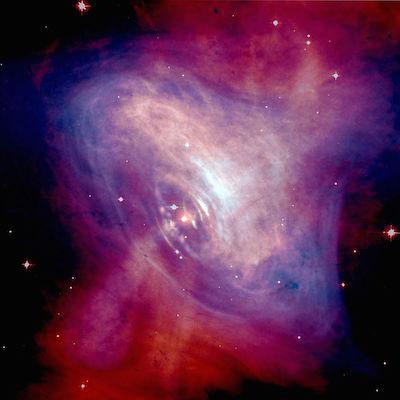
So, about the stars
What a person can see in the sky is not even close to what is actually happening there. What is revealed to our eyes is a very reduced past of our universe. Therefore, when it comes to stars, a person usually either has an image of bright dots in the sky, or something very similar to our Sun, hovering in the depths of space.In fact, most stars are these "boring" gaseous, brightly glowing balls. But there is something incredible in the vastness of space! Although it looks to us the same small and dim dot in the sky.
I will not scientifically describe the evolution of stars or the Hertzsprung-Russell diagram here. I want to show how diverse the concept of "star" is and how this diversity does not correlate with what we put into this term from childhood (and some, like me, to later times).
Brown dwarf
For example, here is a star for you - Gliese 229B. Brown dwarf.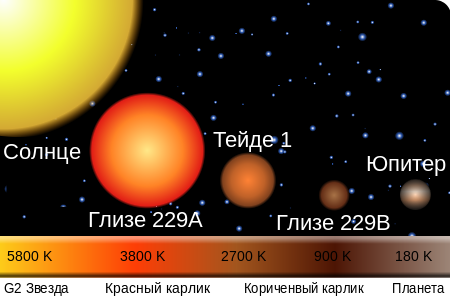
This is the exact opposite of the meaning of the word itself - "star" - brilliance, radiance.
Jupiter is very similar to this star, and in fact, not much different from it. Some varieties of brown dwarfs are called hot Jupiters. But there are still differences. Although the radius of these stars is comparable to that of the giant planets, they are generally tens of times more massive, as well as emitting infrared and X-rays.
Flying next to such a star, we will see it looking like a kind of night lamp. No crown, no bright glow, no squinting eyes, and so on. Imagine that you are looking at the Sun through a welding helmet. A reddish-glowing planet of red-hot lava is what this star would look like to our eyes. And this is at best.
Ultra-cool brown dwarfs don't shine at all!
Being nearby, we would most likely see just a dark ball blocking the starry sky. And if the distance from us to the star was the same as from the Earth to the Sun, we would most likely not know that we were flying past a star at all! Any planet is usually illuminated by the star located in the center of its orbit, but ultra-cool brown dwarfs are, so there is no one to illuminate them.
It is also interesting that planetary systems are also possible around brown dwarfs! Scientists have found that often these already faint stars are surrounded by a disk of dust similar to the one from which our solar system formed.
It is sad that we cannot see a single brown dwarf in the sky with the naked eye. Even in the mountains and in the best weather for observations.
Star systems
We will be lucky if our dwarf is part of a system of stars. A star system is two or more stars bound together by gravitational forces.Here, for example, is how telescopes see a binary system, of which the aforementioned Gliese 229B (the small ball on the right) is a part.
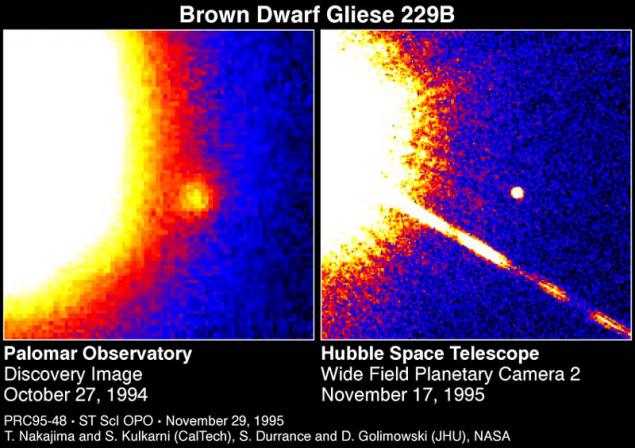
In such a system, an ultra-cool brown dwarf would look very similar to some kind of gas giant planet orbiting a "normal" star.
It turns out that a system of stars is not such a rare phenomenon. And this is another surprising fact. Some of the stars we see are actually huge star clusters, which appear to us as a single bright star because of their vast distance. And some are not so huge, the so-called multiple stars. Let's dwell on each of the systems in more detail.
Take any two stars in the sky that seem close to each other. In fact, almost all of them are far from each other "deeper" into space. Almost everyone. There are exceptions.
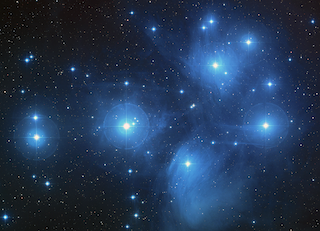
For example, in the sky, the Pleiades are clearly visible to our eyes. This is a star cluster in which the stars are actually "close" to each other. I wrote "close" in quotation marks, because the distance between them is calculated in light years. The radius of the cluster is about 12 light years. For comparison, if our Solar System were located approximately in the center of the Pleiades, then the outermost star of the cluster would be one and a half times farther away than the nearest Alpha Centauri.
In good weather and away from cities, you can distinguish 10-14 of the brightest representatives of this cluster, but in fact there are about 1000 of them! The sky on the planet inside the Pleiades would look simply magical! The cluster consists mainly of bright blue giants. They would decorate the sky with beautiful bluish-white lights, but, unfortunately, they would not allow the origin of life similar to ours due to the destructive radiation that literally penetrates the entire region of this star system.
In clusters, stars usually do not have a clear center of mass. But there are systems, like the one mentioned above, consisting of multiples of the number of stars that are very close to each other, even by the standards of our Solar System, and orbit around a common center of mass. They are called multiple systems of stars, or simply multiple stars.
A good example is the Mizar-Alcor system in the constellation Ursa Major.
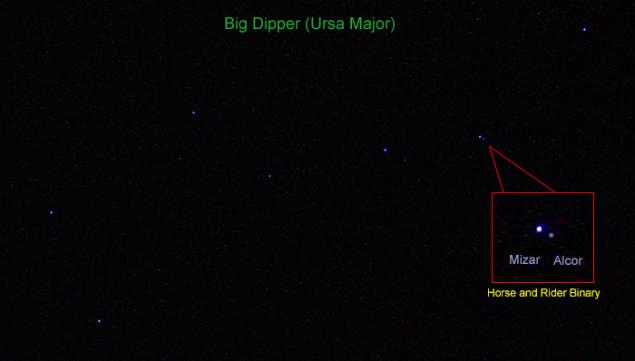
Look at the Big Dipper, even near the city you can notice that the second star of the dipper (Mizar) in the constellation actually consists of two stars, the other, smaller one, is Alcor. She was actually physically close to her neighbor, as it seems to us - at a distance of a quarter of a light year. But even more interesting is that we see two stars, and there are six of them in this system!
And such multiple stars, as it turned out, are not uncommon. A great many of the stars that we see in the sky and consider to be single stars are in fact double, triple, quadruple, quintuple and more! Why don't we notice this? Because, as a rule, either the "secondary" stars are too dim against the background of the "primary" ones, which are many times brighter, or the distance between them is so small that our eyes simply do not have enough resolution to divide their neighbors into separate objects at a great distance.
In such systems, most often the most interesting thing is that the neighbors can be the most different types of stars!
Sirius, the brightest star in the sky, is actually a binary.
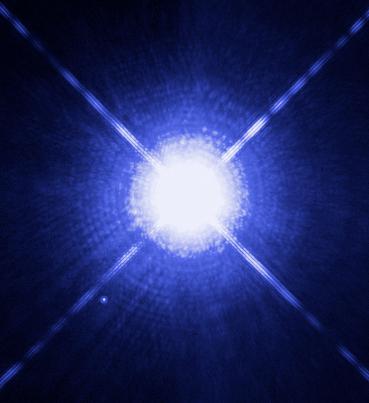
The main star is very ordinary and unremarkable. It is only 1.7 times larger than our Sun. Only it shines 22 times brighter and in a more white-bluish light, unlike our luminary. Its companion, Sirius B, is a white dwarf. Its radius is approximately equal to the radius of our Earth, and its mass is approximately equal to the mass of our Sun!
Ultra-dense stars
A white dwarf is a small, dim star, formerly the core of a red giant. The formation of such stars, without going into complex details, can be explained by the victory of gravity. The cessation of internal thermonuclear reactions in the red giant leads to the shedding of its shell and an incredibly strong compression of the core. The matter of a star is so densely enclosed in a small volume that 1 cubic centimeter of its matter would weigh 10 tons on Earth! Despite the seemingly boring view (flying nearby, we would see a white, brightly glowing ball, the size of a planet), the beauty of white dwarfs in their surroundings. Often, a powerful explosion tears matter from the surface of the red giant and carries it into the surrounding space at great speed. The resulting cloud, which we know as a nebula, pleases our eyes with all the colors of chemical elements that were once formed in the bowels of the dead star.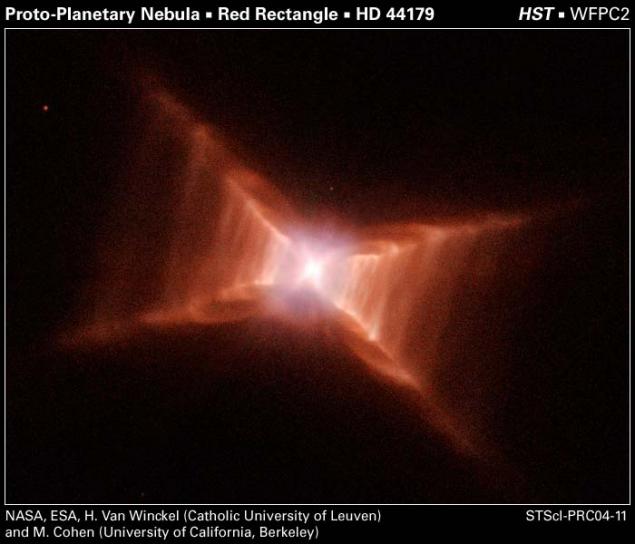
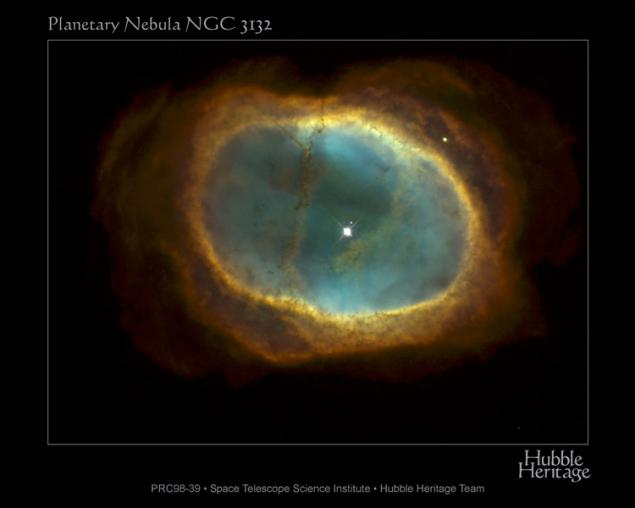
The second image shows the nebula NGC 3132. Here, the primary star is not a white dwarf (it is slightly smaller and slightly taller), but it was the primary star that caused the primary star to eject matter. Imagine what beauty we could observe while being inside this nebula — in the orbit of this binary star. We would have to arm our eyes to see anything more than an ordinary sky with stars. The nebula looks so beautiful only from afar. From a great distance, the cloud appears dense, but in reality, the matter is highly dispersed, and up close, most likely, no different from our night sky. However, if we put the camera on a long exposure on a hypothetical planet next to the central star, we would see a fantastically beautiful sky – a multi-colored nebula covering the entire firmament with all its bars!
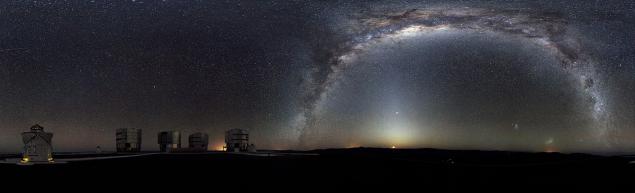
Remember the beautiful color photos of the Milky Way. They are made with great aging. Our eyes do not see anything like this.
With its small size, the white dwarf, due to its enormous mass, has a significant gravitational influence on its surroundings. Here, for example, is a photo where, although the dwarf himself is not visible, his influence is clearly visible.
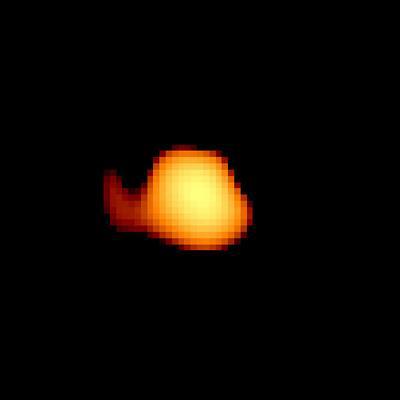
Here, the sphere on the right is a giant star, the matter of which is mercilessly devoured by the white dwarf on the left. In the process, matter flows from one neighbor to another, swirling around a massive (albeit tiny compared to the victim) star and gradually settling on its surface. An accretion disk is formed, which is a very beautiful phenomenon from the point of view of observation. Imagine Saturn's rings that glow like the Sun. Only these rings are much larger, twisted in a spiral and one of the ends of the rings goes directly into the body of the star, forming an elongation in the form of a giant wave on its surface! And in our sky, we can observe an ordinary point of light instead.
Let's move on to the white dwarf's brother, the neutron star.
When a red giant bids farewell to life, it has a chance to give birth to something denser than a white dwarf. If the mass of the star exceeds the Chandrasekhar limit, a neutron star is formed from the core of the giant. Its mass is still comparable to the mass of the Sun, but its size is quite amazing - the radius of neutron stars is only 10-20 kilometers! Due to the rapid decrease in size, like a skater spinning by pulling his hands to his body, these stars rotate at incredible speeds! Many of the neutron stars rotate at speeds of up to 1,000 revolutions per second. That's about 10 times faster than a car's crankshaft at maximum rpm!
Interestingly, due to gravitational distortion, if we could see the heterogeneity of the neutron star's surface, we would see more than half of the disk.

Neutron stars are also part of multiple systems and form accretion disks.
Speaking of accretion disks, it is also worth noting the Cygnus X-1 system. Although, according to scientists, there is a black hole there. In fact, this system is the first of the candidates for black holes. The fact is that Cygnus X-1 emits strong X-ray radiation, and this is the first sign of the presence of a black hole and an accretion disk around it, formed by a donor, a nearby blue supergiant.
I do not advise you to fly close to such systems, powerful radiation will kill all life on your spaceship long before you get even close enough to distinguish the accretion disk from the glare of a giant.
The accretion disk in the movie "Interstellar" is shown very beautifully. But, unfortunately, there was no victim star.
Black holes are not really stars, and they probably deserve a separate article, of which there are a huge number on the Internet.
Planetary systems
Finally, I would like to talk about stars with planetary systems. The discovery of exoplanets is relatively recent, but the number of planets and candidates already found is staggering! Just over the past year, a little less than a thousand exoplanets have been discovered!Remember, when you looked at the sky 10-15 years ago, could you think that billions of planets orbit around the stars that you see? (Judging by the Wikipedia article, there are about 100 billion planets in the Milky Way.)
What planetary systems look like – we can tell from our own experience – is quite boring if you are not near any of the planets.
But if the planets are just forming, the spectacle becomes much more interesting! Dust and gas gather around a common center, a luminous cloud, forming a disk-like nebula illuminated from within. The star in the center does not yet have clear boundaries, and the denser cloud around it does not allow you to see it. The clumps, which may become planets in the future, cast even shadows that go to the edges of the disk.
Most likely, there is no need to arm the eye here - the flatness and illumination of the matter will allow us to observe the birth of a new Star System in all its glory.
Conclusion
It is amazing how much our ancestors put into the concept of a star, and how much has been added to it over the past centuries! It remains only to wait for humanity to be able to freely study the celestial bodies, approaching them directly, in order to personally confirm the theories discovered on the tip of the pen. What other beautiful photos will fill scientific articles? What will the world of stars be like for future us?..P.S.
I deliberately did not post here numerous paintings of stars in the imagination of artists. Only photos and diagrams. I've heard somewhere that the best video card in the world is our imagination!
Source: geektimes.ru/post/242578/