1405
One large or many small?
Have you experienced ever for the fate of the interplanetary probe? Large apparatus, which have invested years of work, stuffed with advanced scientific instruments, is a distant planet's atmosphere, and not the fact that will respond to the surface. Precedents enough - probes broken, destroyed in the atmosphere, or fell silent for some unknown reason. And the whole mission is wasted. Even if the fit successfully passed, only one device can not be simultaneously in several places and had to choose between a plurality of potential points of interest. Also the place was supposed to be safe - the risk of loss of the probe outweighed scientific interest. But now orbiting the Earth fly tens of micro- and nano-satellites, that if we apply this idea to interplanetary probes?
The first success The first mission, where, together with a large probe flew several small, became the «Пионер-Венера-2», launched in 1978. Large unit sat near the equator, and three small dispersed in hand. One sat on the ~ 60 ° N, the second - far on the night side, and the third - on the day. The design was simple machines:
1- antenna 2 - thermometer, 3 - thermal protection, 4 - a sealed container with batteries and electronics, 5 - нефелометр, 6 - radiometer.
Small cell phones did not even have a parachute. "Day" unit exceeded expectations designers, sustained a blow on the surface and another hour to transfer data.
losing streak The next station that bore the "clip" devices, has become over-ambitious « Mars-96 ». The heaviest Martian station, except the orbital module, carrying two landing stations and two penetrators:
Landing station in amortization inflatable shell had to sit down on parachutes and penetrators - stabilized tapered inflatable braking device and stick to Mars at a speed of about 80 m / s. After impact, the front part was supposed to sink to 5-6 meters, the unwinding of a wire, and transmit data to the tail section, remains on the surface.
Each penetrator was carrying 10 scientific instruments and promised to gather unique data about Mars. Until now, no one device does not sink so deep in Mars. It is a pity that the station did not go to Mars with the Earth's orbit and burned up in the atmosphere after a few hours.
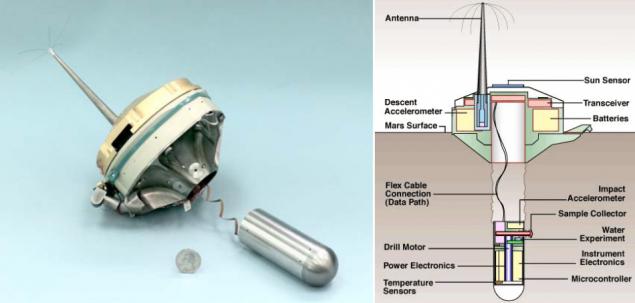
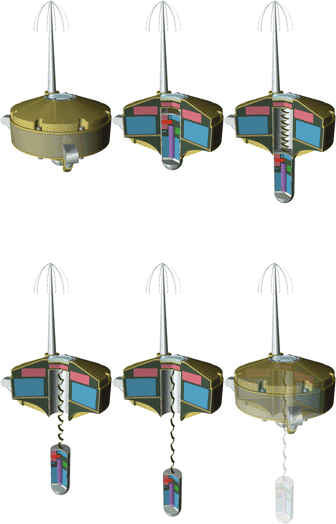
In the 90 years NASA launched the program «New Millennium» , in which, together with the device Mars Polar Lander went to Mars two small probe Deep Space 2 < / a>. They were placed in a heatproof aeroobolochke:
Separated shortly before landing, they had to fall without a parachute, to break the shell with the impact and immerse the front part of a foot in Mars:
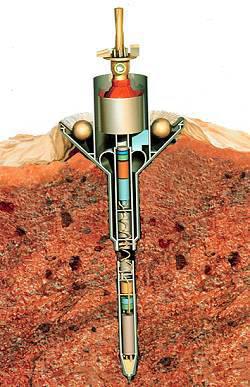
Third December 1999 phones plunged into the atmosphere of Mars, but no big Mars Polar Lander, no small penetrators to communicate and did not leave. Cause of the accident and all devices remained unknown.
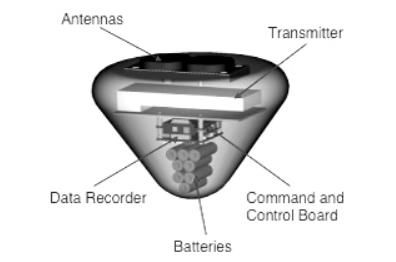
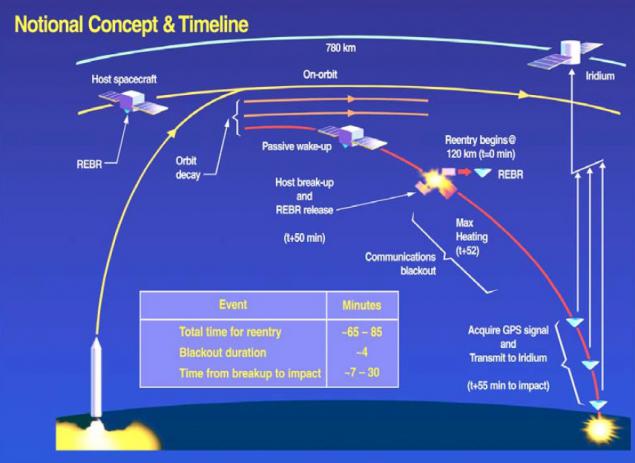
A branch In the zero years about the idea of small devices written articles, but the real interplanetary station carried a maximum of one unit for the descent to the Юпитер, Mars or Титан. But the concept of a simple machine that is able to withstand entry into the atmosphere, got curious offshoot. Information about the passage of the apparatus dense layers of the atmosphere offered a record in the "black box" that would survive the destruction of the main unit and would be able to transfer the data for further investigation. Thus was born the project Reentry Breakup Recorder (REBR), which is already three times recorded in the destruction of the dense atmosphere of cargo ships supplying the ISS and successfully transmit data.
Machine Diagram. Nothing complicated - the battery, the device lock and data transmitter
Technology-based REBR proposed project Pico Re-Entry Probe, very cheap universal unit, able to withstand braking in the dense layers of the atmosphere and transmit data. For example, it is proposed to set the concurrent load satellites:
The orbit of the satellite carrier gradually degrades, it burns up in the atmosphere and PREP transmits data directly to a satellite connection, without the need of search and selection
With PREP suggested to obtain data on the behavior of subsystems and materials spacecraft, or, for example, to spend cheap atmospheric research.
New Hope In recent years, the number of ideas applying micro-, nano- and pikozondov increased dramatically. Last summer wrote about probes chip "chipsaty" proposed dump on Jupiter's moon Europa.
In the spring of this year at the University of Toronto suggested reset swarm devices into Jupiter's atmosphere (project SMARA ):
And in March, a non-profit organization Planetary Science Institute invited project MARSDROP :
In the development of aeroobolochke proposed to place the probe with a controlled landing parachute-wing. This combination is expected to be able to provide an exact fit in the interesting from the point of view of science portion of the surface of Mars - fresh crater, canyon area of volcanic activity, the glacier. The developers believe that such a probe will be able to fly in the Martian atmosphere up to 10 km, compensating for the inevitable inaccuracy of braking in the atmosphere, and deliver the unit weight of 1 kg exactly to the target. It is expected that the two devices MARSDROP, passing loads taken to the main mission, it will increase the cost of no more than 5%.
Analysis The idea of using a swarm of probes for planetary exploration has the following advantages and disadvantages:
Advantages:
- A new level of scientific data collection. Grid devices capable of providing a spatial representation of climate, weather or geological data. One unit is fundamentally unable to do so. Most reliable integrated missions - the failure of one unit is not fatal. Ability to take more risks - you can lose a few vehicles in the Valles Marineris, the Olympus or Hellas Planitia on. More scientific data. Casual slip on landing Chinese lunar rover discovered new information about the geology of the Moon. And if landed a hundred machines?
Disadvantages:
- Limiting the mass of one unit means that it is impossible to put a complex and large scientific instruments. Also, cell phones are unlikely to be able to move or to exist for years. Small size dictate little energy - orbital relay becomes mandatory. Also, a repeater increased demands on data transfer.
In my opinion it is obvious merits outweigh hopefully in the near future, swarms of probes complement our usual large complex machines.
List of references Besides the sources indicated in the text, were used:
- Austin R. Howard, MINIATURIZATION OF ATMOSPHERIC ENTRY PROBES: OPTIONS FOR FUTURE PLANETARY EXPLORATION MISSIONS William H. Ailor, Vinod B. Kapoor, Gary A. Allen, Jr., Ethiraj Venkatapathy, James O. Arnold and Daniel J. Rasky Pico Reentry Probes: Affordable Options for Reentry Measurements and Testing
Source: geektimes.ru/post/249222/
Landing station in amortization inflatable shell had to sit down on parachutes and penetrators - stabilized tapered inflatable braking device and stick to Mars at a speed of about 80 m / s. After impact, the front part was supposed to sink to 5-6 meters, the unwinding of a wire, and transmit data to the tail section, remains on the surface.
Each penetrator was carrying 10 scientific instruments and promised to gather unique data about Mars. Until now, no one device does not sink so deep in Mars. It is a pity that the station did not go to Mars with the Earth's orbit and burned up in the atmosphere after a few hours.
In the 90 years NASA launched the program «New Millennium» , in which, together with the device Mars Polar Lander went to Mars two small probe Deep Space 2 < / a>. They were placed in a heatproof aeroobolochke:
Separated shortly before landing, they had to fall without a parachute, to break the shell with the impact and immerse the front part of a foot in Mars:
Third December 1999 phones plunged into the atmosphere of Mars, but no big Mars Polar Lander, no small penetrators to communicate and did not leave. Cause of the accident and all devices remained unknown.
A branch In the zero years about the idea of small devices written articles, but the real interplanetary station carried a maximum of one unit for the descent to the Юпитер, Mars or Титан. But the concept of a simple machine that is able to withstand entry into the atmosphere, got curious offshoot. Information about the passage of the apparatus dense layers of the atmosphere offered a record in the "black box" that would survive the destruction of the main unit and would be able to transfer the data for further investigation. Thus was born the project Reentry Breakup Recorder (REBR), which is already three times recorded in the destruction of the dense atmosphere of cargo ships supplying the ISS and successfully transmit data.
Machine Diagram. Nothing complicated - the battery, the device lock and data transmitter
Technology-based REBR proposed project Pico Re-Entry Probe, very cheap universal unit, able to withstand braking in the dense layers of the atmosphere and transmit data. For example, it is proposed to set the concurrent load satellites:
The orbit of the satellite carrier gradually degrades, it burns up in the atmosphere and PREP transmits data directly to a satellite connection, without the need of search and selection
With PREP suggested to obtain data on the behavior of subsystems and materials spacecraft, or, for example, to spend cheap atmospheric research.
New Hope In recent years, the number of ideas applying micro-, nano- and pikozondov increased dramatically. Last summer wrote about probes chip "chipsaty" proposed dump on Jupiter's moon Europa.
In the spring of this year at the University of Toronto suggested reset swarm devices into Jupiter's atmosphere (project SMARA ):
And in March, a non-profit organization Planetary Science Institute invited project MARSDROP :
In the development of aeroobolochke proposed to place the probe with a controlled landing parachute-wing. This combination is expected to be able to provide an exact fit in the interesting from the point of view of science portion of the surface of Mars - fresh crater, canyon area of volcanic activity, the glacier. The developers believe that such a probe will be able to fly in the Martian atmosphere up to 10 km, compensating for the inevitable inaccuracy of braking in the atmosphere, and deliver the unit weight of 1 kg exactly to the target. It is expected that the two devices MARSDROP, passing loads taken to the main mission, it will increase the cost of no more than 5%.
Analysis The idea of using a swarm of probes for planetary exploration has the following advantages and disadvantages:
Advantages:
- A new level of scientific data collection. Grid devices capable of providing a spatial representation of climate, weather or geological data. One unit is fundamentally unable to do so. Most reliable integrated missions - the failure of one unit is not fatal. Ability to take more risks - you can lose a few vehicles in the Valles Marineris, the Olympus or Hellas Planitia on. More scientific data. Casual slip on landing Chinese lunar rover discovered new information about the geology of the Moon. And if landed a hundred machines?
Disadvantages:
- Limiting the mass of one unit means that it is impossible to put a complex and large scientific instruments. Also, cell phones are unlikely to be able to move or to exist for years. Small size dictate little energy - orbital relay becomes mandatory. Also, a repeater increased demands on data transfer.
In my opinion it is obvious merits outweigh hopefully in the near future, swarms of probes complement our usual large complex machines.
List of references Besides the sources indicated in the text, were used:
- Austin R. Howard, MINIATURIZATION OF ATMOSPHERIC ENTRY PROBES: OPTIONS FOR FUTURE PLANETARY EXPLORATION MISSIONS William H. Ailor, Vinod B. Kapoor, Gary A. Allen, Jr., Ethiraj Venkatapathy, James O. Arnold and Daniel J. Rasky Pico Reentry Probes: Affordable Options for Reentry Measurements and Testing
Source: geektimes.ru/post/249222/
In the spring of this year at the University of Toronto suggested reset swarm devices into Jupiter's atmosphere (project SMARA ):
And in March, a non-profit organization Planetary Science Institute invited project MARSDROP :
In the development of aeroobolochke proposed to place the probe with a controlled landing parachute-wing. This combination is expected to be able to provide an exact fit in the interesting from the point of view of science portion of the surface of Mars - fresh crater, canyon area of volcanic activity, the glacier. The developers believe that such a probe will be able to fly in the Martian atmosphere up to 10 km, compensating for the inevitable inaccuracy of braking in the atmosphere, and deliver the unit weight of 1 kg exactly to the target. It is expected that the two devices MARSDROP, passing loads taken to the main mission, it will increase the cost of no more than 5%.
Analysis The idea of using a swarm of probes for planetary exploration has the following advantages and disadvantages:
Advantages:
- A new level of scientific data collection. Grid devices capable of providing a spatial representation of climate, weather or geological data. One unit is fundamentally unable to do so. Most reliable integrated missions - the failure of one unit is not fatal. Ability to take more risks - you can lose a few vehicles in the Valles Marineris, the Olympus or Hellas Planitia on. More scientific data. Casual slip on landing Chinese lunar rover discovered new information about the geology of the Moon. And if landed a hundred machines?
Disadvantages:
- Limiting the mass of one unit means that it is impossible to put a complex and large scientific instruments. Also, cell phones are unlikely to be able to move or to exist for years. Small size dictate little energy - orbital relay becomes mandatory. Also, a repeater increased demands on data transfer.
In my opinion it is obvious merits outweigh hopefully in the near future, swarms of probes complement our usual large complex machines.
List of references Besides the sources indicated in the text, were used:
- Austin R. Howard, MINIATURIZATION OF ATMOSPHERIC ENTRY PROBES: OPTIONS FOR FUTURE PLANETARY EXPLORATION MISSIONS William H. Ailor, Vinod B. Kapoor, Gary A. Allen, Jr., Ethiraj Venkatapathy, James O. Arnold and Daniel J. Rasky Pico Reentry Probes: Affordable Options for Reentry Measurements and Testing
Source: geektimes.ru/post/249222/
- Limiting the mass of one unit means that it is impossible to put a complex and large scientific instruments. Also, cell phones are unlikely to be able to move or to exist for years. Small size dictate little energy - orbital relay becomes mandatory. Also, a repeater increased demands on data transfer.
In my opinion it is obvious merits outweigh hopefully in the near future, swarms of probes complement our usual large complex machines.
List of references Besides the sources indicated in the text, were used:
- Austin R. Howard, MINIATURIZATION OF ATMOSPHERIC ENTRY PROBES: OPTIONS FOR FUTURE PLANETARY EXPLORATION MISSIONS William H. Ailor, Vinod B. Kapoor, Gary A. Allen, Jr., Ethiraj Venkatapathy, James O. Arnold and Daniel J. Rasky Pico Reentry Probes: Affordable Options for Reentry Measurements and Testing
Source: geektimes.ru/post/249222/
- Austin R. Howard, MINIATURIZATION OF ATMOSPHERIC ENTRY PROBES: OPTIONS FOR FUTURE PLANETARY EXPLORATION MISSIONS William H. Ailor, Vinod B. Kapoor, Gary A. Allen, Jr., Ethiraj Venkatapathy, James O. Arnold and Daniel J. Rasky Pico Reentry Probes: Affordable Options for Reentry Measurements and Testing