2868
Interesting and informative, controlled landing on the PTK NP

The next stage is large and, I hope, an interesting series of training posts in Flight Orbiter. Once in a previous post, we have successfully docked with the ISS, the obvious next task - to go back to the earth, to make an accurate fit with acceptable congestion.
This post has a purpose:
- Share PTK NP ship. To give an idea of the physics of braking maneuvers and landing. Provide a simple guide for precise landing in Orbiter.
Previous Post
This cycle of posts about Orbiter comes from the idea of a consistent increase in complexity. Before flying on this manual recommends that you read the previous post:
History of Cosmonautics . Observation of the flights of without the active participation.
«Breeze-M» . Basic maneuvers, access to the GSO.
flight to the ISS . Maneuvers for rendezvous and docking.
A bit of history and theory
Big "broads" Chelyabinsk meteorite very clearly shows what happens to the unprepared cosmic body falling into the atmosphere at high speed. Movement in the atmosphere causes friction, which in turn leads to heat. If the unit is included in the atmosphere, is not protected by special engineering solutions, it will collapse.
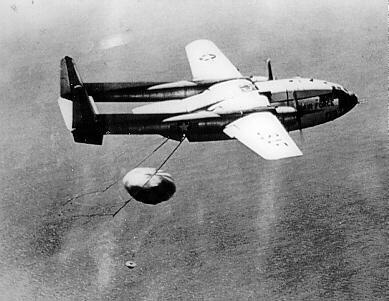
Historically, the return of vehicles from orbit due to the manned flight and photo-reconnaissance satellites (back film footage). The first object returned from orbit, has become an empty capsule film (the technology of) "Discoverer-13", landed 10 August 1960. August 18 returned capsule with exposed film, "Discoverer-14»:
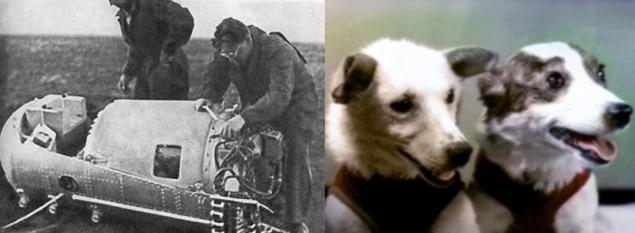
Aug. 19 and landed Belka and Strelka:
Braking in space
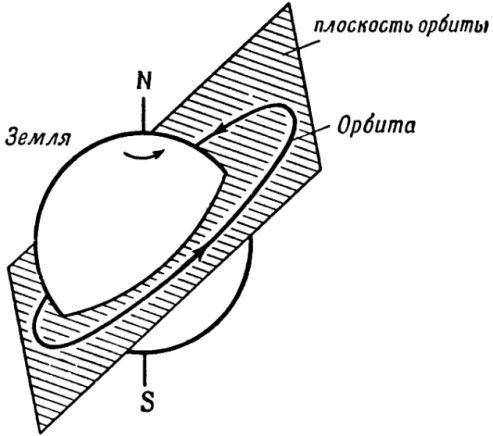
The first problem to be solved - the timing retroburns. Earth rotates on its axis, and the seat rotates with it. The satellite is spinning in its orbit, the plane of which is usually inclined relative to the axis of rotation of the Earth:
If you draw a line on the map motion of the satellite above the Earth, then we obtain the sine wave, which eventually shifted to the left on the map due to the rotation of the Earth:
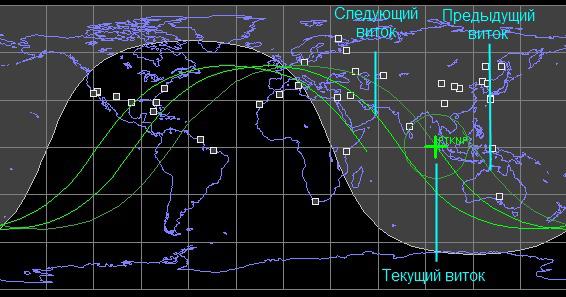
Therefore, if we want to land in the landing area, you can do so far on each pass. But knowing the orbit of the ship, you can predict when the landing will be in the plane of the orbit.
The second challenge - to give the desired braking impulse. Each real spacecraft has a valid range of angles of entry into the atmosphere. If the angle is too large, the density of the atmosphere will continue to grow too quickly, and this will cause an overload invalid or unacceptable thermal load on the heat shield. If the angle is too small, the atmosphere will not be able to "capture" the device, and he will fly back to space.
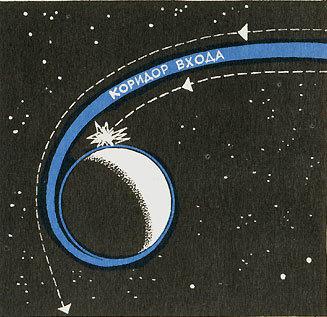
Braking in the atmosphere
The third task - to survive atmospheric drag. For this unit is equipped with a special thermal protection. Ablative heat shield is made of a plurality of layers asbestotekstolita impregnated puddle of phenol-formaldehyde resins. It burns slowly, like a book, in layers, losing the burnt layer brought from the outside temperature. This one-time thermal protection, it has been used since the beginning of space exploration, and is widely used now. Second Embodiment - composite materials and ceramics, which are made from reusable tiles covering apparatus. "Space Shuttle" and "Buran" using this option.
The fourth task - descent control. Initially, the descent was unmanageable. Soviet units were round, they are automatically oriented in the flow as Roly-Poly and down along a ballistic trajectory. This scheme is very robust, it is used today in the scientific and biological satellites "Photon" and "Bion". American vehicles used thrusters and twist to maintain flight mode heat shield forward. Ballistic descent has serious flaws - overload reaches 9 g when returning from a circular orbit, 12 g when returning from the Moon, and the landing area is measured in hundreds or even thousands of square kilometers. Therefore, developers have begun to develop space technology devices with a controlled landing - "Apollo" and "Union". The idea is realized in them, identical. Placing the center of gravity outside the axis of symmetry causes the apparatus that flies under steady angle of attack creates lift:
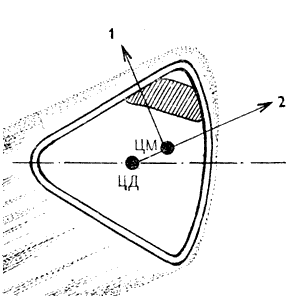
This lifting force is spent on the following steps:
- The slowdown reducing device that stretches the brake, reducing congestion. Manage reduction, which allows more accurate landing.
Planting
Fifth task - a soft landing. In the US, all ships except the shuttle landed on the water. Water "softer" landing ground at low speed, and a large fleet of the United States quickly and efficiently raise on board the gearing. In the USSR "Vostok" cosmonaut ejected at a height of several kilometers, so that instead of hitting the ground in the machine, to amortize kicks. "Sunrise" and "Union" used parachute-rocket system: install a small parachute gives the rate of descent, and before the touchdown reduce its jet engines, ideally to zero.
PTK NP
Now being developed Prospective Piloted Transport System (PCA), she manned transport ship the new generation (PTK NP) - a ship with a sufficiently long and interesting history. And we need to talk and explain what it does, and why it uses the selected technical solutions.
Why does he need?
This is not an idle question. The fact that the ship "Union" was originally designed to fly to the moon and, theoretically, can cope with the tasks set before PTK NP. For soon fifty years of operation "Union" has gained a reputation sort of cosmic "Gazelle" - not very comfortable, close, but hardy and reliable ship. Why change it to something new? However, there are reasons. Despite all its advantages, "Union" has flaws that can not be corrected modernization:
- The Economy. Disposable and reusable fully ships were not very successful extremes. Partially reusable ship, which can only be replaced consumable components such as the heat shield must be cheaper and easier to use. "Union" do not be a partially reusable - hit the ground during landing violates warranty on the hull strength. You can (and do) to remove nodes from the flying ship and put on a new one, but since it is not by design, is not very effective. The large size landing zones. Now landing zone "Union" have become perceived as large. Room for maneuver during the descent limited design lander - high "spotlight" can not reach the high angles of attack. Exact fit is not compatible with the opening of the parachute at an altitude of 10 km - a few minutes of descent wind can carry the ship at a great distance. The ballistic descent. Ballistic descent mode requires a separate backup of the landing: the first area to a controlled landing, the second - in the event of failure in the ballistic descent. Overloading 9 g is not like space tourists, and when returning from the moon in 12 g overload is becoming a health hazard. Worse, the failure in ballistic descent when returning from the moon the "Union" means ditching the Indian Ocean, which now will not do. The tightness. Union - close enough ship. Of course, astronauts do not get used to overcome the hardships of space flight, but, why not remove them if it is possible? And if we are going to carry space tourists, then upload them better more, and they provide acceptable conditions. A small weight of the return shipping. Lander "Union" can return only 50 kg of cargo along with the crew that inconvenience. A small stock of characteristic velocity. If we are going to fly to the moon, it would be desirable to have more than now, the stock characteristic velocity (delta-V). Soviet lunar program was extremely, at the level of flight safety risk is limited by fuel due to insufficient carrying capacity rocket H-1, and a simple increase in the instrument-aggregate compartment "Union" is not possible without actually creating a new ship.
Goodbye, wings
One notable technical decisions taken at PTK NP, was the refusal of the wings (compare with «Клипером» and «МАКСом»). PTK NP - a capsule, a bit like the American "Apollo." The fact that the wings are not compatible with versatility. They help to make exact fit, but this benefit is not comparable to the losses that would arise if the overclock useless in space mass and aerodynamic wings surfaces of the Moon, based at the Lagrange point, asteroids or Mars.
Special landing
Another notable technical solution became landing system PTK NP. Originally, it was meant to completely reactive, because this scheme gives the most accurate fit. However, fully reactive landing raises questions of safety, so parachutes back. In its current form landing system consists of the following steps:
- At the height of several kilometers reset the heat shield (as in the Union). Three chutes are deployed at an altitude of 1, 5 km. As used three domes, reserve parachute is not necessary (failure of one of the dome gives the allowable increase in the rate of decline).
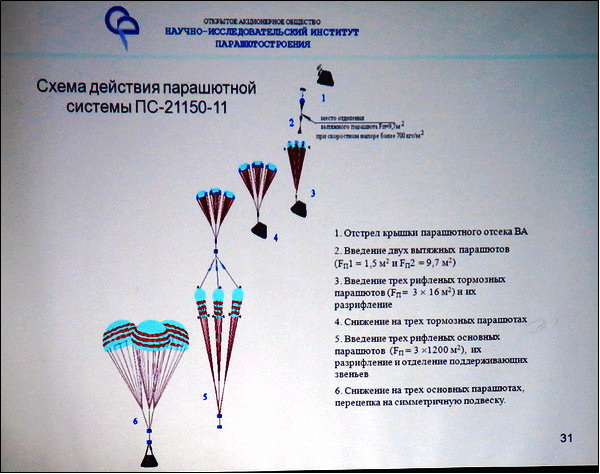
Reveals the landing shock absorbers.
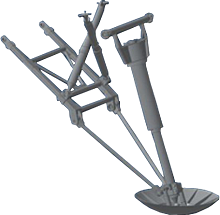
Just before touchdown triggered reactive complex landing system. She retorts side wind drift (if any) for the vertical drop of the capsule and reduces the rate of descent to the soft touch. Energy touch the ground amortized landing gear shock-absorbing seats and crew (as a precaution).
The history of the development
It all began, probably with the idea of ACTS - with ESA spacecraft to fly to the moon, about the middle of zero. Originally planned, apparently, a modified "Union" with the upper stage "Fregat" and the joint Russian-European equipment:
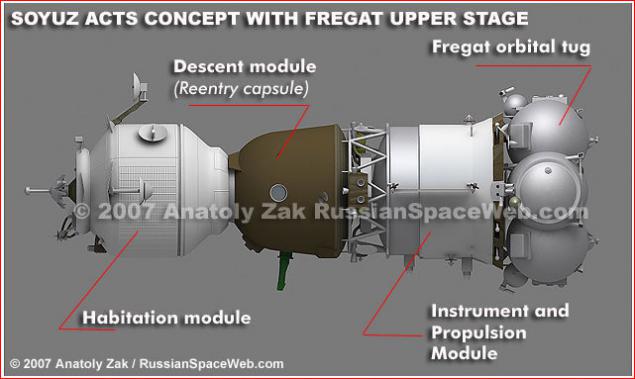
By the end of the zero idea of joint ESA ship died, the ship began to be developed as soon as the Russian, and, instead of modifying the "Union", began to create from scratch. Typical for the end of the zero became the lander with the influx side thrusters:
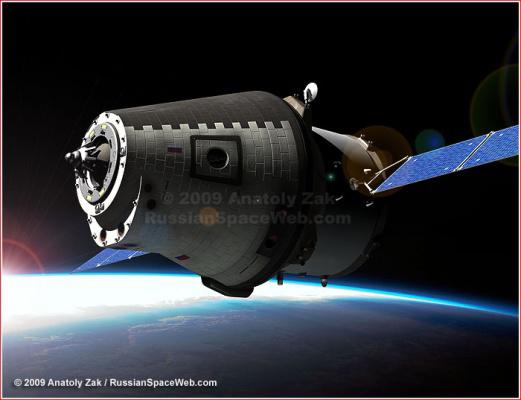
Since the beginning of the influx of teens disappeared:
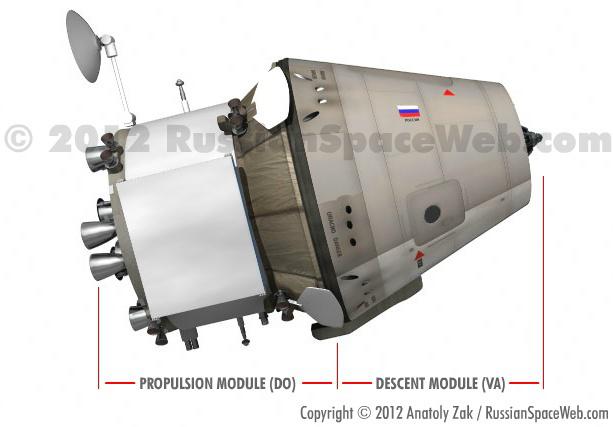
This model is implemented in Orbiter. It is outdated and not very realistic (why 8 main engines?).
The most recent time the appearance of a ship in public - MAKS 2013:
Work very actively conducted, they are regularly tells TV Roscosmos. Last movie - the program "Space", shown last Saturday:
news sources
Monitor progress on PTK NP can be on:
- By type topic at the forum "Space News» Channel TV Roscosmos Blog test cosmonaut Mark Serov , who works in the Roman Catholic Church "Energy" on PTK NP.
Preparing to fly
For this flight, we need:
- himself Orbiter , if you have not downloaded it Addon PTK NP Addon Aerobrake MFD
flight plan
This flight can be divided into the following stages:
- The combination of the orbital plane from the landing site. Braking for de-orbit. Controlled deceleration in the atmosphere. Landing.
Step 1. Combining the orbital plane from the landing site
Load script. I choose to save in the previous post flight, so I found it interesting, you can also use your save or load the same scenario PTK NP - Docked to ISS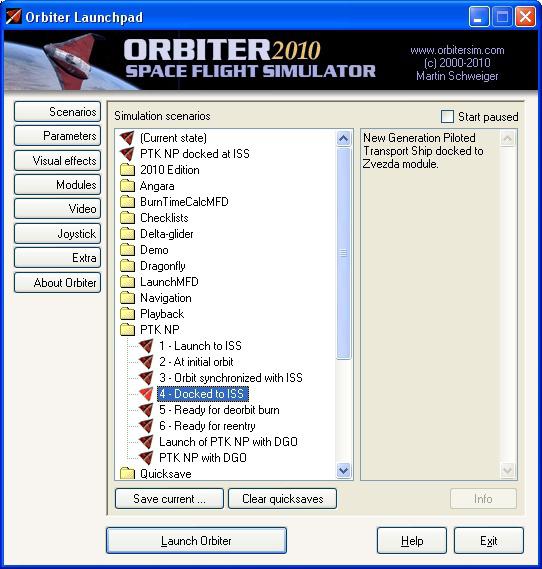
So we docked to the ISS.
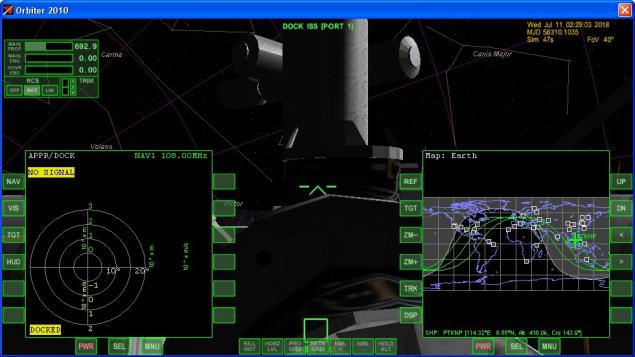
We want to return to the cosmodrome "East", so the MFD cards choose it as a goal ( Right Shift - T Spaceports - Vostochny Left Shift - F1 Left Shift - E Left Shift-T Vostochny Ctrl-D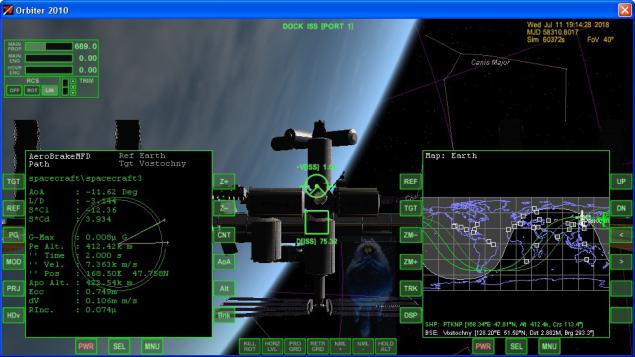
Goodbye, ISS!
Step 2. Sedation for de-orbit
After a disagreement with the ISS, we're waiting for the East to remain 18,000 km, focusing on the inhibition of the ship stern first and give impetus to the de-orbiting at a time when East remains to 17,000 km.
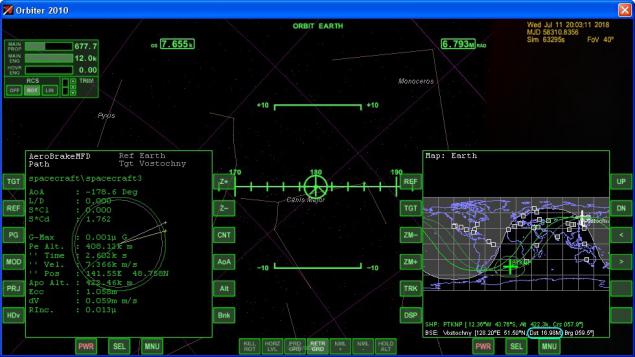
Brake before until MFD Aerobrake not show undershoot 1000 km:
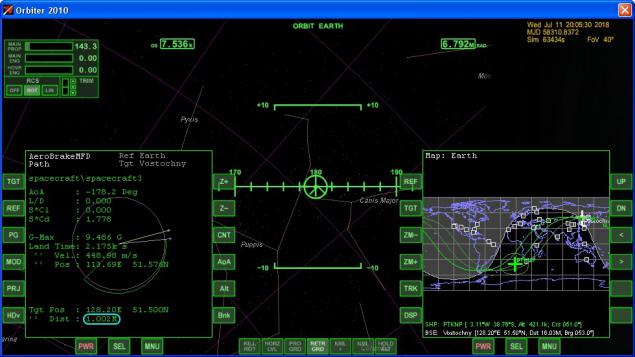
Undershoot we need for the utilization of the aerodynamic qualities.
Step 3: Controlled deceleration in the atmosphere
Before entering the atmosphere must produce more separation compartments. Orient the ship in position against the orbital velocity vector (feed forward) and with zero roll. There is a good automatic attitude control "on the horizon» - L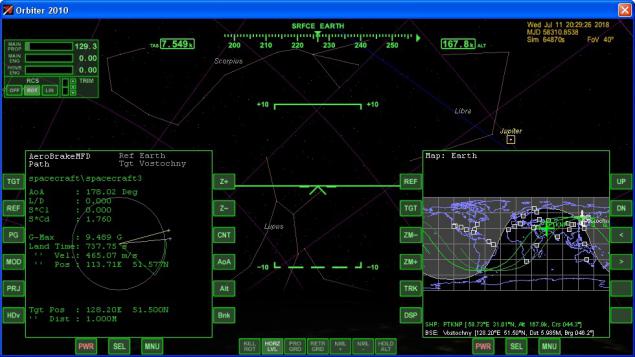
Wait a height of 150 km and a shooting cable-mast by pressing K J PRJ PG Right Shift - F1 Right Shift - S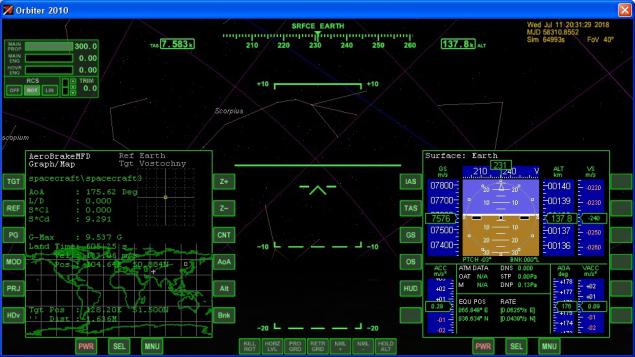
Our two control methods will be trimmer and roll. Trimmer set buttons Ins Del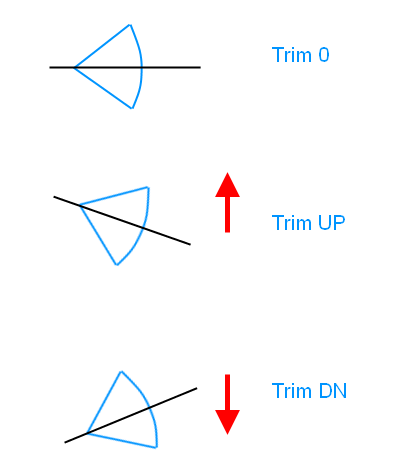
In reality, this angle is fixed, but then, fortunately, we can change it, it adds flexibility.
By changing the angle of heel, we can create the lateral component of the lift force to displace the north or south. If the device was more maneuverable, could spend the excess energy, moving "snake", but I have not got it.
At an altitude of 130 km, where there are the first signs of the atmosphere, set the pitch angle of 10 degrees and set up trimmer to the maximum.
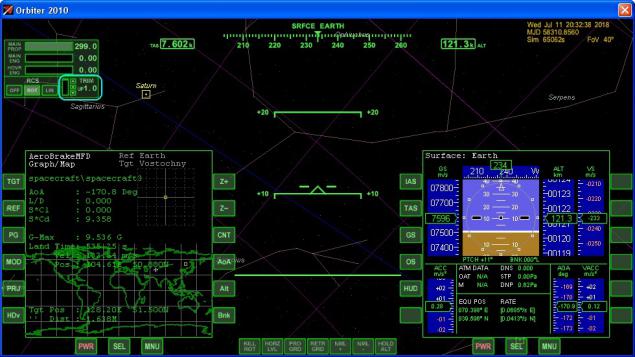
per 100 km is the time to play music in the subject
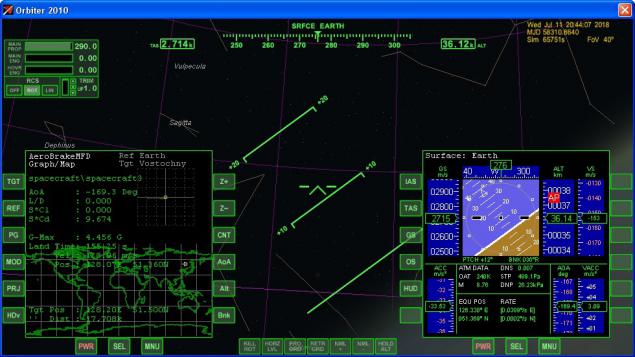
In the process of decline from the beginning of the effects of the atmosphere capsule set to the pitch angle of about 12 degrees. Possible fluctuations, but do not let the strong buildup parry her regime KILLROT ( Num 5 Height 65 km note on reducing undershooting the left MFD and display a noticeable lift in the right MFD:
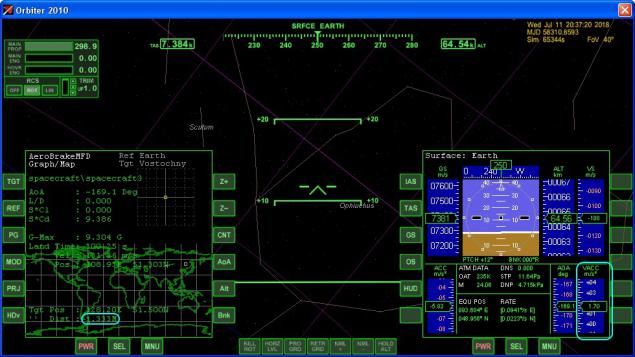
The height of 61 km. The capsule has already lost one kilometer per second, and goes to climb due to the lift:
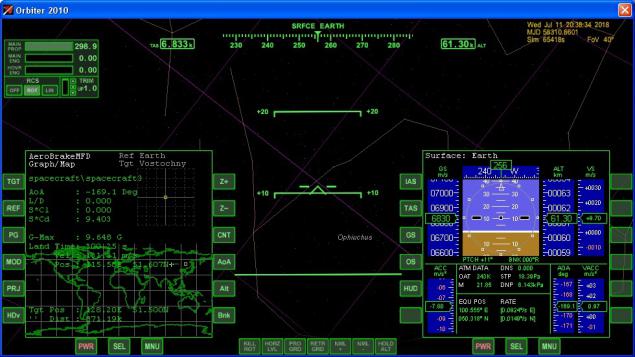
The height of 50 km. On the left MFD appears on top of our flight track:
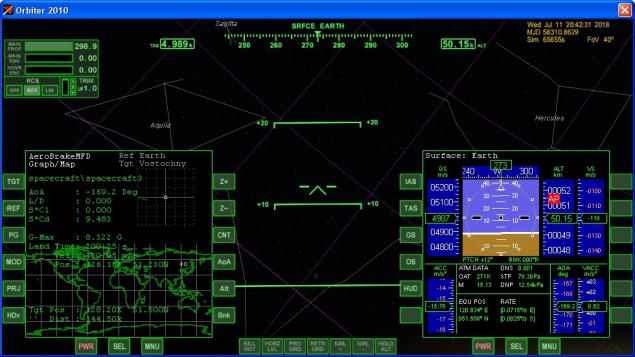
Judging by the track, we will go a little further south. To move to the north, we have to ship tilted to the right. In this case, the lift will get a side component, deflecting us to the north. It is necessary to strike a balance between the preservation of lift and shift sideways, not to sit down with undershoot.
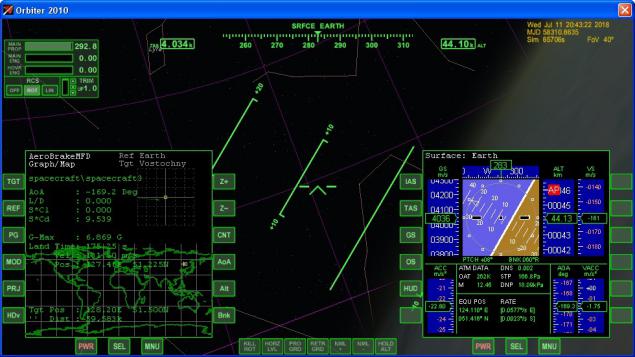
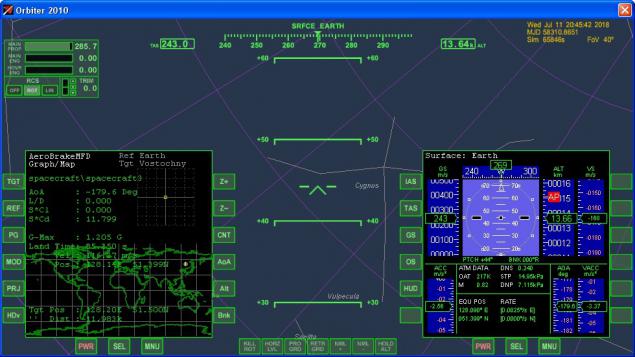
At a height of less than 40 km return the ship in a vertical position - the speed drops, the lift drops. Note overload - 3, 3 G - quite comfortable, and it has already reduced. This can overload and public transport experience.
Less than 15 km zero out trimmer us it will not help. Error 12 km, sorry, more than I would like.
Planting
At a height of not less than 5 km parachute compartment hatch reset by pressing the J K J G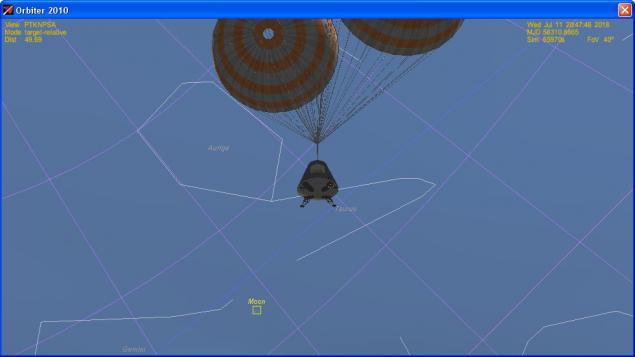
- The combination of the orbital plane from the landing site. Braking for de-orbit. Controlled deceleration in the atmosphere. Landing.
- himself Orbiter , if you have not downloaded it Addon PTK NP Addon Aerobrake MFD
- By type topic at the forum "Space News» Channel TV Roscosmos Blog test cosmonaut Mark Serov , who works in the Roman Catholic Church "Energy" on PTK NP.
- At the height of several kilometers reset the heat shield (as in the Union). Three chutes are deployed at an altitude of 1, 5 km. As used three domes, reserve parachute is not necessary (failure of one of the dome gives the allowable increase in the rate of decline).
- The Economy. Disposable and reusable fully ships were not very successful extremes. Partially reusable ship, which can only be replaced consumable components such as the heat shield must be cheaper and easier to use. "Union" do not be a partially reusable - hit the ground during landing violates warranty on the hull strength. You can (and do) to remove nodes from the flying ship and put on a new one, but since it is not by design, is not very effective. The large size landing zones. Now landing zone "Union" have become perceived as large. Room for maneuver during the descent limited design lander - high "spotlight" can not reach the high angles of attack. Exact fit is not compatible with the opening of the parachute at an altitude of 10 km - a few minutes of descent wind can carry the ship at a great distance. The ballistic descent. Ballistic descent mode requires a separate backup of the landing: the first area to a controlled landing, the second - in the event of failure in the ballistic descent. Overloading 9 g is not like space tourists, and when returning from the moon in 12 g overload is becoming a health hazard. Worse, the failure in ballistic descent when returning from the moon the "Union" means ditching the Indian Ocean, which now will not do. The tightness. Union - close enough ship. Of course, astronauts do not get used to overcome the hardships of space flight, but, why not remove them if it is possible? And if we are going to carry space tourists, then upload them better more, and they provide acceptable conditions. A small weight of the return shipping. Lander "Union" can return only 50 kg of cargo along with the crew that inconvenience. A small stock of characteristic velocity. If we are going to fly to the moon, it would be desirable to have more than now, the stock characteristic velocity (delta-V). Soviet lunar program was extremely, at the level of flight safety risk is limited by fuel due to insufficient carrying capacity rocket H-1, and a simple increase in the instrument-aggregate compartment "Union" is not possible without actually creating a new ship.
- The slowdown reducing device that stretches the brake, reducing congestion. Manage reduction, which allows more accurate landing.
