How to choose a country for your child's education abroad

Planning a child's education abroad is a strategic decision that affects their future education, career, and quality of life. One of the first and most important steps is to choose the right country for study.
It is at this stage that parents have the most questions: which country is suitable in terms of education, budget, safety, and prospects after graduation. The choice is not always obvious, because each country has its own peculiarities of the education system, admission requirements, and approaches to learning.
Therefore, the question of how to choose a country to study abroad requires a comprehensive approach, taking into account not only the prestige of universities, but also the individual characteristics of the child.

1. Age of the child and stage of education
The first criterion is age and current level of education. This determines not only the country, but also the format of study:
- 10–14 years old — boarding schools in Great Britain, the USA, or Canada are more often chosen
- 15–17 years old — A-levels (British high school program) or IB (International Baccalaureate program) are popular
- 17+ — university admission or Foundation preparatory programs
For example, in Great Britain, it is important to plan admission in advance due to the difference in the education system, while in the USA there is more flexibility in choosing programs.
2. Budget for tuition and accommodation
The cost of education varies significantly depending on the country. It is important to consider not only tuition, but also accommodation, food, and additional expenses.
- USA, Great Britain — high budget, but top universities
- Canada — balance of price and quality
- Germany — possibility of free education, but language requirements
- Netherlands — affordable programs in English
The right choice of country allows you to optimize costs without losing the quality of education.
3. Language of instruction and level of preparation
Another important factor is the level of English or knowledge of other languages. If the child does not yet have a sufficient level, it is worth considering:
- preparatory language programs
- Foundation (preparatory year before university)
- schools with academic support
In European countries, such as Germany, knowledge of the local language is often required, while in the Netherlands and Canada more programs are available in English.
4. Career prospects after graduation
It is important to look not only at education, but also at opportunities after it. Some countries offer favorable conditions for graduates:
- opportunity to stay and work after graduation
- simplified visa application
- access to the international labor market
For example, Canada and the Netherlands have clear programs for graduates that allow them to stay in the country and gain work experience.
5. Safety and adaptation of the child
For parents, the issue of comfort and safety is important. It is worth considering:
- level of safety of the country
- availability of support for international students
- mentality and cultural peculiarities
Some countries, such as Great Britain, have a developed system of support for students in schools and universities, which greatly facilitates adaptation.
Typical mistakes when choosing a country
Parents often focus only on the popularity of the country or advice from acquaintances. This can lead to a mismatch between expectations and reality.
- choosing a country without considering the child's abilities
- ignoring admission requirements
- underestimating the budget
- lack of long-term plan
To avoid these mistakes, it is worth approaching the choice systematically and taking into account all factors.
How to make the right decision
The best option is to consider several countries at once and compare them according to key parameters: cost, requirements, prospects, comfort for the child.
It is also important to take into account the interests of the teenager and his future profession, because different countries are strong in different academic fields.
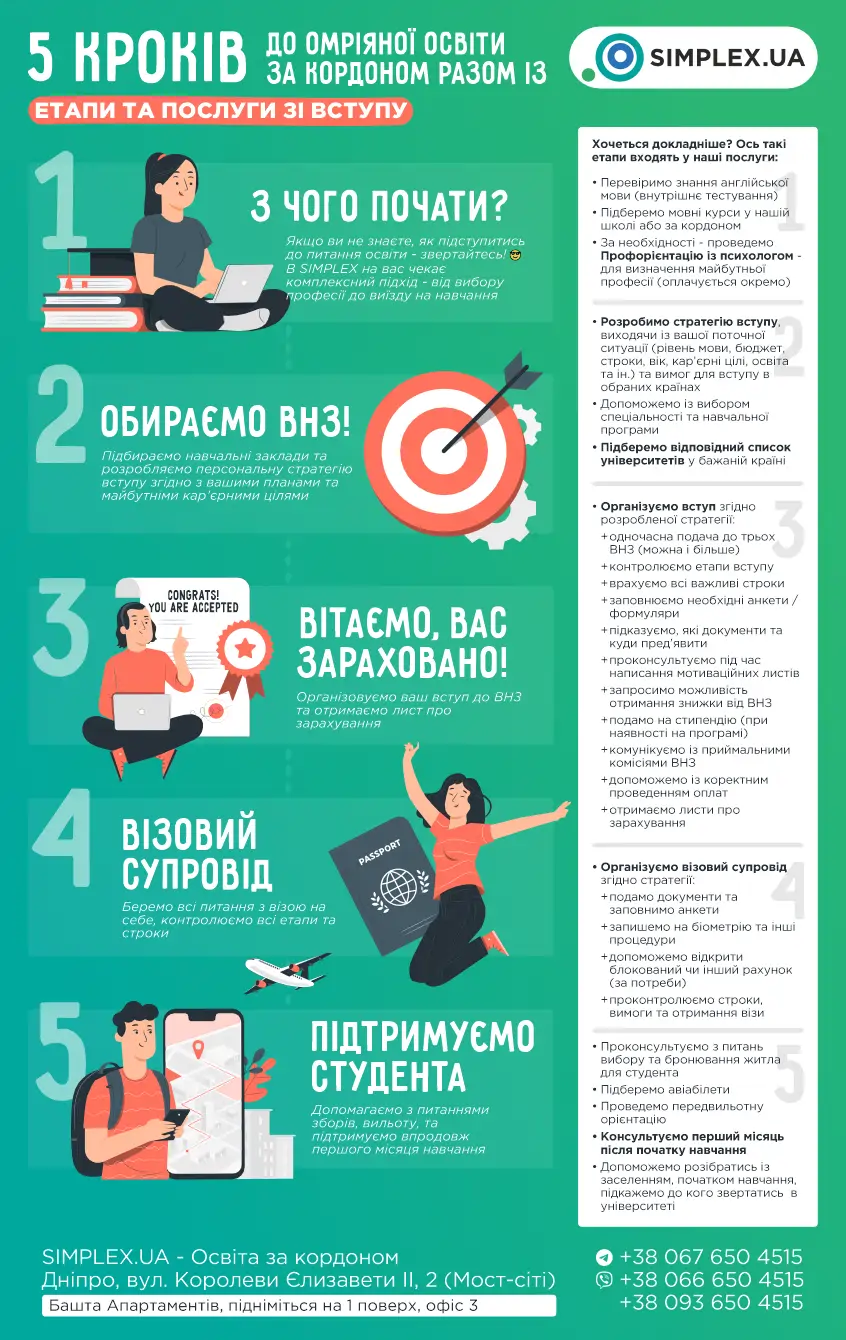
If you are just starting to understand the topic and want to get more information about study abroad opportunities, you should turn to trusted sources, such as https://simplex.ua/, where basic directions and program options for different ages are collected.
The SIMPLEX.UA agency has many years of experience in supporting admission abroad and helps to choose the optimal country, program, and strategy for a specific child, taking into account their level, goals, and budget.