1209
7 important facts about the rover «Curiosity»

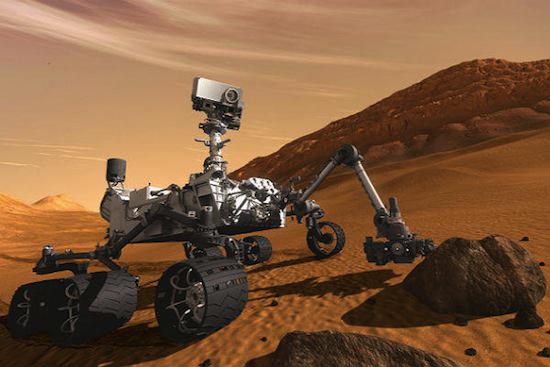
Sixth August Mars Rover landed a new generation, called «Curiosity» - «Curiosity». About its features, differences from existing earlier Mars rovers and on what mission he has to perform, we asked to speak to a senior researcher Vladimir SAI Surdina.
1.
Pretty good climate investigated as eight years old were monitored continuously in the last two - «Spirit» and «Opportunity». Now we know how the temperature is running across the sky, some sand, some dust flying in the atmosphere at different times of the year in areas where sat phones (near the equator). On Mars varies greatly throughout the year the wind speed, the density of the atmosphere - and now it's pretty well known.
2.

In fact it is the first car that will explore Mars is not two-dimensional, three-dimensional as well. She can climb well, she has a very high cross-country. It is expected to climb the hill and maybe even a few kilometers up the mountain rises. In addition, the devices can also look down into the pit, and up at the slopes of some cliffs. Not very high, about ten meters. Still, this is a three-dimensional scanning, which is very important. If you see some kind of a vertical wall, the geological layers on it tell you the story of the past million years. Previously, geologists have only looked at it through the picture transmitted from Mars, and now may be a laser beam, centimeter by centimeter to measure the chemical composition and to read the geological record.
3.
Eighteen months ago, we found that out of the surface of Mars goes methane - a gas or volcanic or animal origin. We have it allocates cattle or microbes under the surface; marsh gas - is also methane. Here we know that methane on Mars, and now we know what its isotopic composition. If there is similar to terrestrial microbes work, it will be possible to prove (or disprove) that a product zhiznedeyatelsnosti, not volcanoes. Volcanoes on Mars should not be, there is pretty cool, and they have frozen billions of years ago. Therefore, there is little doubt that this biogas. But it is necessary to check, and now it can do.
4.
Video rover, of course, does not remove all the time. He has two computers are in parallel (just in case), the memory of each of them - only a USB flash drive 2 gigabytes. It's only consumer memory is cheap and great. But on Mars is quite high levels of radiation, so the memory is very special, resistant to radioactivity, and computers very special. And yet, there are two identical set. This is not a lot of memory to install, it is protected specifically, there is a constant duplication, verification of mathematical methods to failures. But 2 gigabytes - is too much! It makes little sense to permanently transfer a movie from Mars. Still, the machine moves slowly such shazhochkami, moving things on Mars, too, is not particularly large. But the video is high quality: frame size of 1600 by 1200, and rich colors. In general, the picture will be much better than previous devices.
5.
For the first time in the rover did not use solar panels and nuclear heat source. There plutonium-238 decays and warm about it with such power as dvuhkilovattny kettle. Compared to the previous Mars rovers this - a giant. It produces 125 watts of electricity to all its engines, all devices is more than enough. And yet - to keep him warm, because Mars is cold at night and many of the rover requires a fairly stable temperature, especially scientific instruments. Here is also the heat generator will give them at night, which is also very important. It is enough to 20-35 years. The radioactive element is gradually losing power, but the half-life in his 88 years, so if all goes well, a few dozen years, the rover will be able to work.
6.
When less reflected neutrons, which means that we have a depth from the surface up to a meter (not visible on) for some lighter material containing most likely hydrogen atoms. Well, that may be a hydrogen atom? Obviously, the water can not think of anything else - hardly there all filled with oil, hydrocarbons. Thus the judge of a layer of ice beneath the surface of the permafrost. And it's very interesting. Until now, this was done only from orbit, but the orbit visible only large areas, and now will be the first time along the route to probe the meter by meter. If you suddenly see that a lot of water under the wheels, you can stop and this robotic arm to dig. Maybe get to the water layers and analyze its composition, it will generally be fine. It seems that it might not be very deep. Previous American unit "Phoenix" four years ago, sat in the high latitudes, about the latitude of our Murmansk. There, on Mars, something similar to the tundra. Digging about 5-7 centimeters, he raked his "hand" layer of snow. But it's in the tundra, and «Curiosity» is now virtually on the equator. It is unlikely that there below the surface at a depth of five centimeters will lay the ice because at the equator of Mars is warm to 15-20 degrees Celsius. But if the machine kopnet 30-40 centimeters (this is my purely intuitive argument), there is already the temperature is always below zero during the day and night, so there is ice may persist. That would be great, because the isotopic composition of the water speaks of its history, where it came from, what was the atmosphere, where it went.
7.
So in the crater Gale is very clearly evident, which means that the rock from the bottom of the lower layers got a meteor explosion. This is very interesting: it is not necessary to dig, and you simply climbing the mountain, get a lot of deep geological layers. «Spirit» and «Opportunity» only on level ground running, on the sand. And then, if the rover will be able to climb this mountain, it layer by layer analyze the deep history of Mars. There are layers were deposited over hundreds of millions of years.
via factroom.ru
The most secure password in the world, you can enter it, but can not remember
10 most bizarre sea creatures